

Author’s note: this post was originally published on LessWrong in 2022; I’m rehosting it here on Substack for posterity. It pairs well with In Defense of Punch Bug, originally published on Medium in 2018, which I have also rehosted here.
Abstracts
Benign Boundary Violations:
Society sets cautious/conservative boundaries, relative to most people (but NOT all), which means that for most people (but NOT all) there exists space between society’s boundaries and their own personal boundaries, and playing around in that space is deeply nourishing for many people. It’s important to feel alive and seen and touched and interacted-with in the space outside of your personal boundaries, and not feel like there's a ten-foot bubble separating you from all the other monkeys.
In Defense of Punch Bug:
There is a level of boundary violation (of your real, actual personal boundaries, not merely of the social boundary beyond your personal one) that is healthy, and it is greater than zero. Too much boundary violation, and you take real damage and become traumatized, but too little, and you atrophy and get the socio-emotional equivalent of wild autoimmune disorders.
The overlap/synthesis:
If someone treats you in a way that is appropriate to treat an average/unremarkable member of society, and thereby accidentally and unknowingly violates some unstated boundary that you have, or triggers some unusual sensitivity, this person has done nothing wrong and is NOT morally culpable (the first time). Expecting others to pre-guess and preemptively conform to unusual sensitivities is unsustainable on the societal level and leads to anxiety and gridlock. Punishing people for failing to be psychic/failing to preemptively cringe is approximately as bad as knowingly transgressing an explicit boundary.
May 25, 2022
Recently, my brother Eric asked me what sorts of things I wanted to have happen at my bachelor party.
I said (among other things) that I'd really enjoy some benign boundary violations.
Eric went ????
Subsequently: an essay.
We use the word “boundary” to mean at least two things, when we're discussing people’s personal boundaries.
The first is their actual self-defined boundary—the line that they would draw, if they had perfect introspective access, which marks the transition point from “this is okay” to “this is no longer okay.”
Different people have different boundaries:
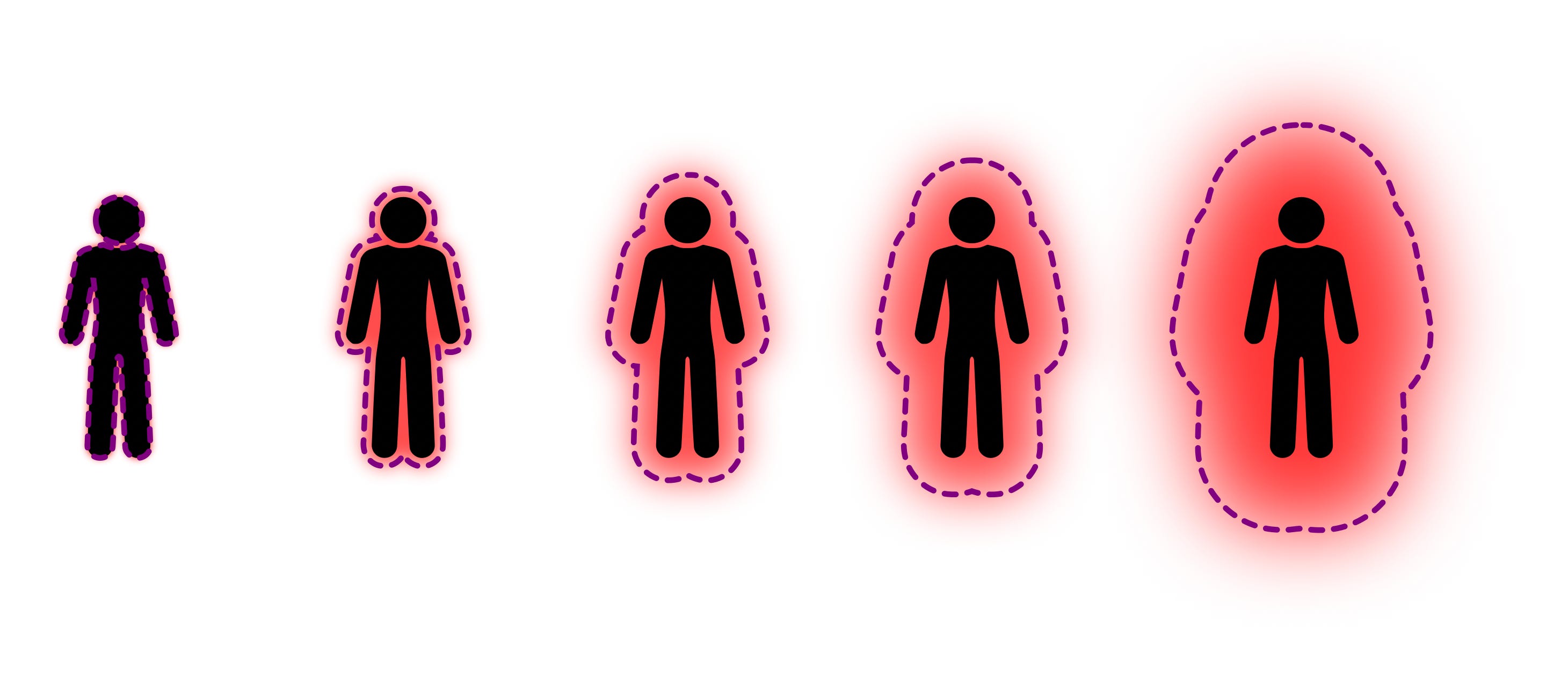
There are all sorts of different domains in which we have those different boundaries. If the above were a representation of people’s feelings about personal space, then the person on the left would probably be big into hugs and slaps-on-the-shoulder, while the one on the right might not be comfortable sharing an elevator with more than one other person (if that).
If the above were instead a representation of, say, people’s openness to criticism, then the person on the left probably wouldn’t mind if you told them their presentation sucked, in front of an audience of their friends, colleagues, and potential romantic partners. Meanwhile, the person on the right would probably prefer that you send a private message checking to see whether they were even interested in critical feedback at this time.
Obviously, a diagram like the one above leaves out a lot of important nuance. For instance, a given person often has different boundaries within the same domain, depending on context—you may be very comfortable with intimate touch with your spouse and three closest friends, but very uncomfortable receiving hugs from strangers. And you may be quite comfortable receiving touches on the shoulder from just about anyone, but very uncomfortable receiving touches on the thigh.
The above also doesn’t do a great job of showing uncertainty in one's boundaries, which is often substantial. The “grey area” between okay and not okay might be quite small, in some cases (you have a clear, unambiguous “line” that you do not want crossed) and quite wide in others where you're not sure how you feel, and you might not know exactly where that gradient begins and ends.
But for any given domain, and any given context, most people could at least a little bit describe where their boundaries lie. They’re okay with the a-word, but not with the f-word. They’re okay with friends borrowing $50, but they’re not okay with family members asking for co-signers on a loan. They’re okay with somebody crumpling up a post-it note and playfully throwing it at them, but they’re not okay being hit in the face with a water balloon.
There’s a different thing altogether that people mean when they talk about boundaries, and that’s something like what society tells us is okay.
This, too, is context-dependent; different subcultures have different expectations and norms between those subcultures can vary a lot. What’s in-bounds on LessWrong is different from what’s in-bounds on Facebook, and what’s in-bounds on 4chan is different still.
But for any given subculture, it seems to me that society tries to set the boundaries at something like “ninety percent of the present/relevant/participating people will not have their personal boundaries violated.”
In other words, the boundary given by social convention is set in approximately the same place as the personal boundary of the 90th-percentile sensitive person.
(Others may disagree with me about the number, and may think that it’s set at seventy percent or ninety-five percent or whatever, and certainly this number, too, varies depending on all sorts of factors, e.g. groups are more likely to be conservative in domains that feel more fraught or dangerous.)
What this means, though, is that most people have a delta between what is okay for them personally, and whats deemed okay by society-at-large. This delta can go either way—relatively sensitive or disadvantaged people are often told that their reaction to a personal boundary violation is “their fault,” or “overreacting,” or “unfortunate, but that’s just something you're going to have to get used to, if you’re going to make it around here,” because the action taken was on the right side of the normative boundary, which was not set via a process which validates their needs.
But in most cases, most people’s boundaries lie within the limit set by the social norm—often well within.
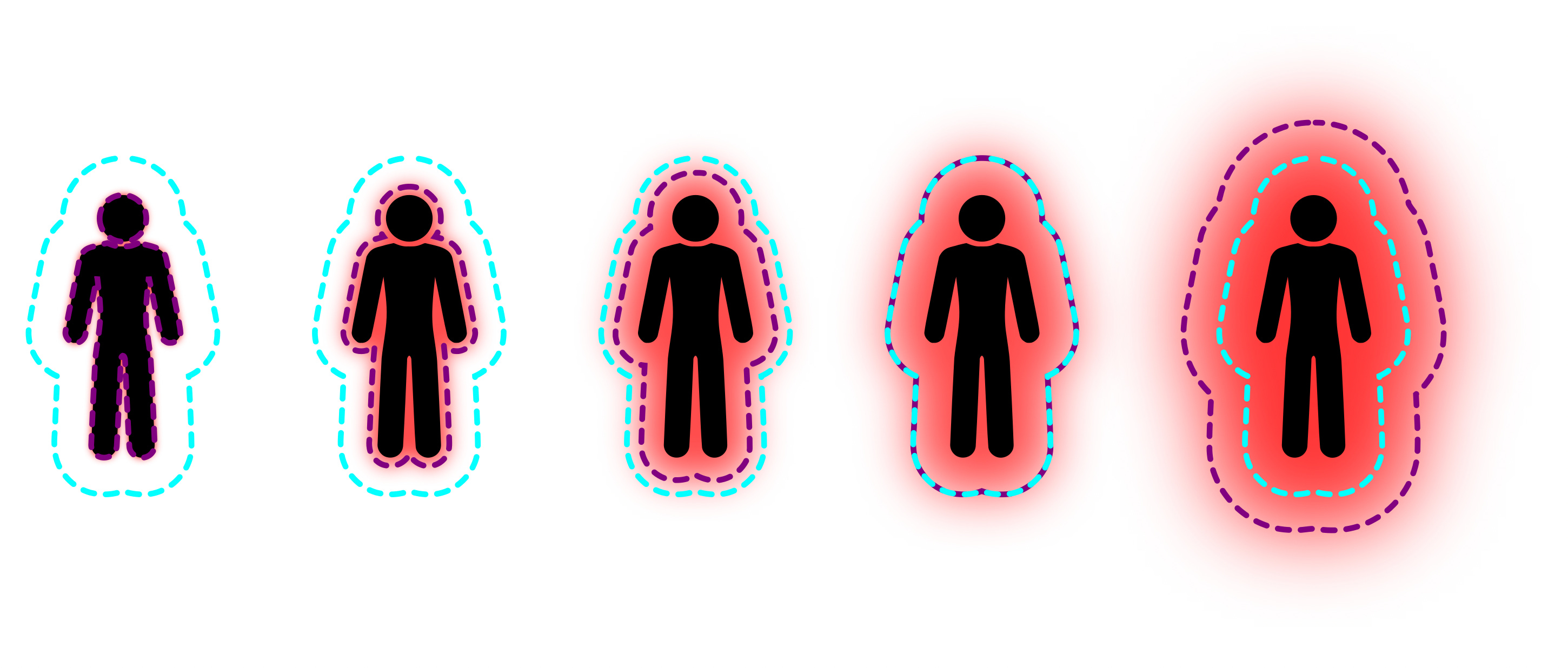
It’s interesting to consider the role that the social boundary plays.
Violations of it—whether we're talking about personal space, or noise pollution, or probing, intimate questions, or whatever—are super common. They’re common in the same way that violations of the speed limit are common, and (I think) for similar reasons.
A relevant anecdote:
I once co-signed a lease on a rental property in Berkeley, CA. The property manager offered us a contract that was full of outlandish terms, such as “no visitors for more than two nights without paying an additional $80/night to the landlord.”
The property manager freely admitted that these terms were absurd, and that he did not expect us to abide by them in the slightest. They were there, he said, so that if we turned out to be assholes, he would have a way to pry us out of the house. Berkeley, CA is extremely friendly to tenants, relative to landlords, so having a contract in which we were unambiguously in breach from day 1 would prove useful.
(Or so the property manager thought, anyway; I don’t know how that would actually play out in court).
This reminded me at the time of traffic law. Approximately everyone is in violation of traffic law at approximately all times. This is usually ignored because it is, in fact, usually fine to go 51mph instead of 45mph.
But the nominal speed limit provides an unambiguous standard to refer to in the event that something else goes wrong. A highway safety patroller may not always be able to make their intuitions about a dangerous traffic situation legible or convincing, but they can say to a judge “well, the person in question was going nine miles per hour over the limit.”
(Here I will not get into questions about the use or abuse of such a power structure, only note that it exists.)
Social boundaries are similarly flexible and permeable. They provide something like a retroactively defensible position.
Take an action which is generically off-limits—say, an open hand placed on someone’s upper arm. This is not the sort of thing one does with strangers in most of America, and in most workplaces this is not the sort of thing one does with colleagues.
It’s also the sort of thing that many people would not, in fact, mind or be threatened by. But the boundary is there in case, because that is in fact scary or disruptive for a non-negligible number of people. If you are in the office and a colleague places their open hand on your arm and you knock their hand away and say “don’t touch me,” the fact that “don’t touch your coworkers” is a common-knowledge boundary provides you with something like ready-made social support. You can be reasonably confident that other people will agree that this is not okay, even if those same people might not have gone so far as to object independently, on their own initiative.
(In the ideal, anyway. Harassment still seems rampant; this may be an overly optimistic example and I’m sure there are people reading who can attest to not being supported in just such an objection. I was tempted to make the example more extreme, but when I imagined doing so it was still easy to imagine readers going “nope, lol, I was literally groped and they still told me it was my fault.” I don't have anything useful to say, except to apologize on behalf of the species Homo Sapiens.)
Another way to say this is that the social boundary is something like a hint, as to what other people will help you prosecute. It’s not a perfect hint, and there’s often imperfect coordination on it, but it’s more like “if X happens and you say don't like it, we will back you up” than it is like “we will proactively object every time X happens.”
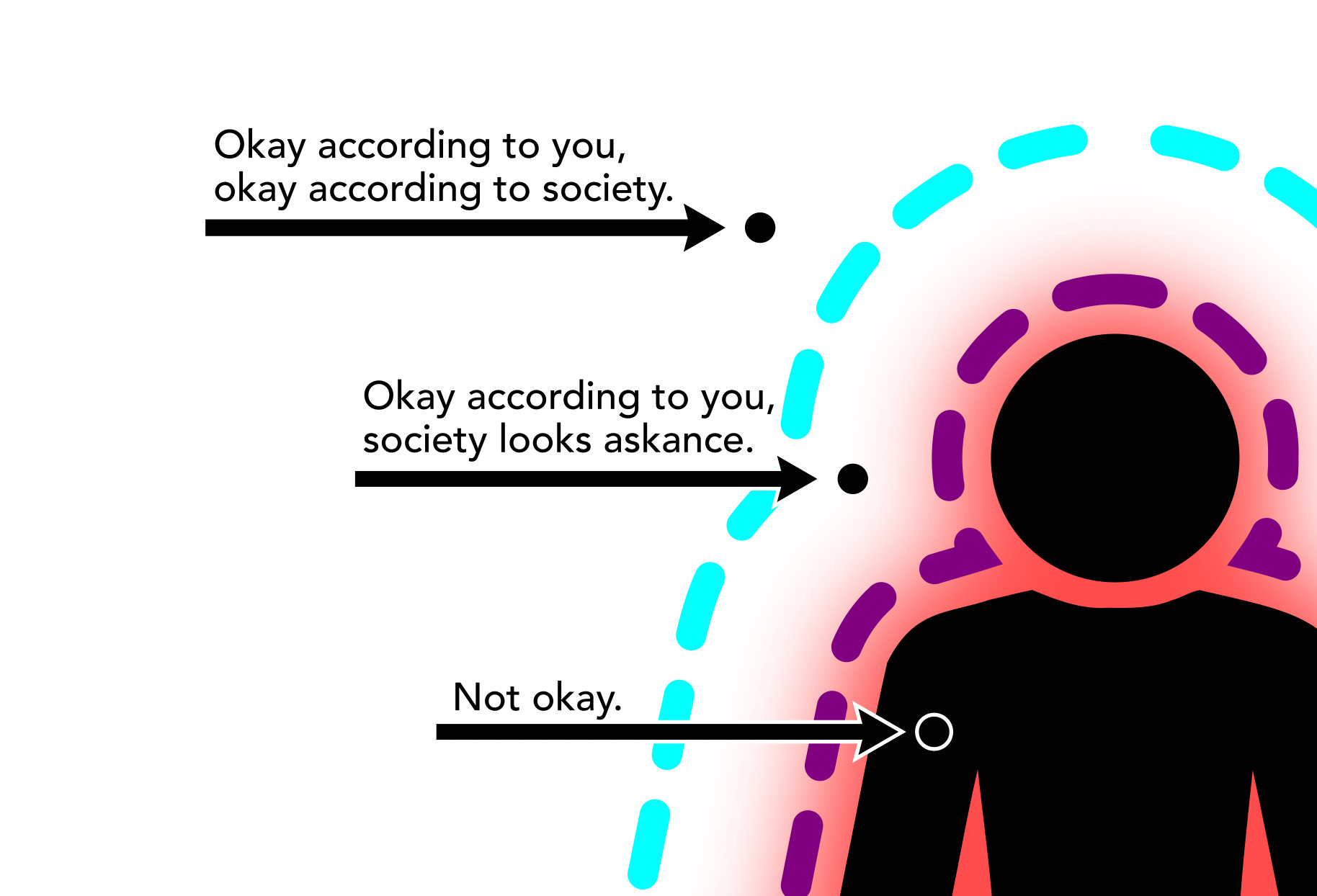
This is because X is (usually) a somewhat broad and conservative boundary, like the speed limit. Which means that, for most people, most of the time, there is room to cross it, without actually infringing on the individual's personal boundary:
A few caveats:
As intimated above, in any given domain, there will be some people for whom that in-between space literally does not exist. If society’s boundaries are set such that they’re already inside of your own personal boundaries, then people behaving “normally” according to the rules of the group are already doing things that are not-okay for you, on the regular, as a matter of course. While this essay is not going to focus on that subset of people, I wanted to pause to acknowledge that a) that subset exists, b) it contains a lot of people, in an absolute sense, and c) what’s happening to those people is unpleasant and in many cases morally bad. It’s not that this mismatch isn’t worth an essay—it is. It’s just not the subject of this essay.
I suspect some people’s minds will have leapt straight to the (true!) point that many actions which penetrate into that in-between space are something like grooming or testing-the-waters—that they are a prelude to, or a harbinger of, some future not-okay action. This seems straightforwardly correct, to me. Again, I want to focus my attention elsewhere, without denying that this is a thing. It is a thing! But I'm not particularly interested in discussing that thing here, nor in getting into the nitty-gritty of how to tell it apart from the other thing, which is not sinister, and not a prelude to anything Bad. Both categories definitely exist, and I’m interested in focusing only on the subset of actions which the individual in question would stably rate as benign. Speaking of which...
For the purposes of my usage here, “benign” is not a label that can be applied to [a violation of the social boundary] absent a specific individual in a specific context. A phrase like “having a pie smushed in your face is a benign boundary violation” is non-valid. The only way to tell that a given social boundary violation is benign is to find out, from the individual, whether it in fact failed to violate their personal boundary. Without an individual to ask, the question “is this benign?” can't be answered.
Another way to say this is that benign-ness is a property that’s determined by how a given action actually lands, not by how it is intended. And the only person qualified to make that evaluation is the recipient.
Yet another way is to say that if it did, in fact, cross your personal boundary, then it was by definition not benign in the sense intended here.
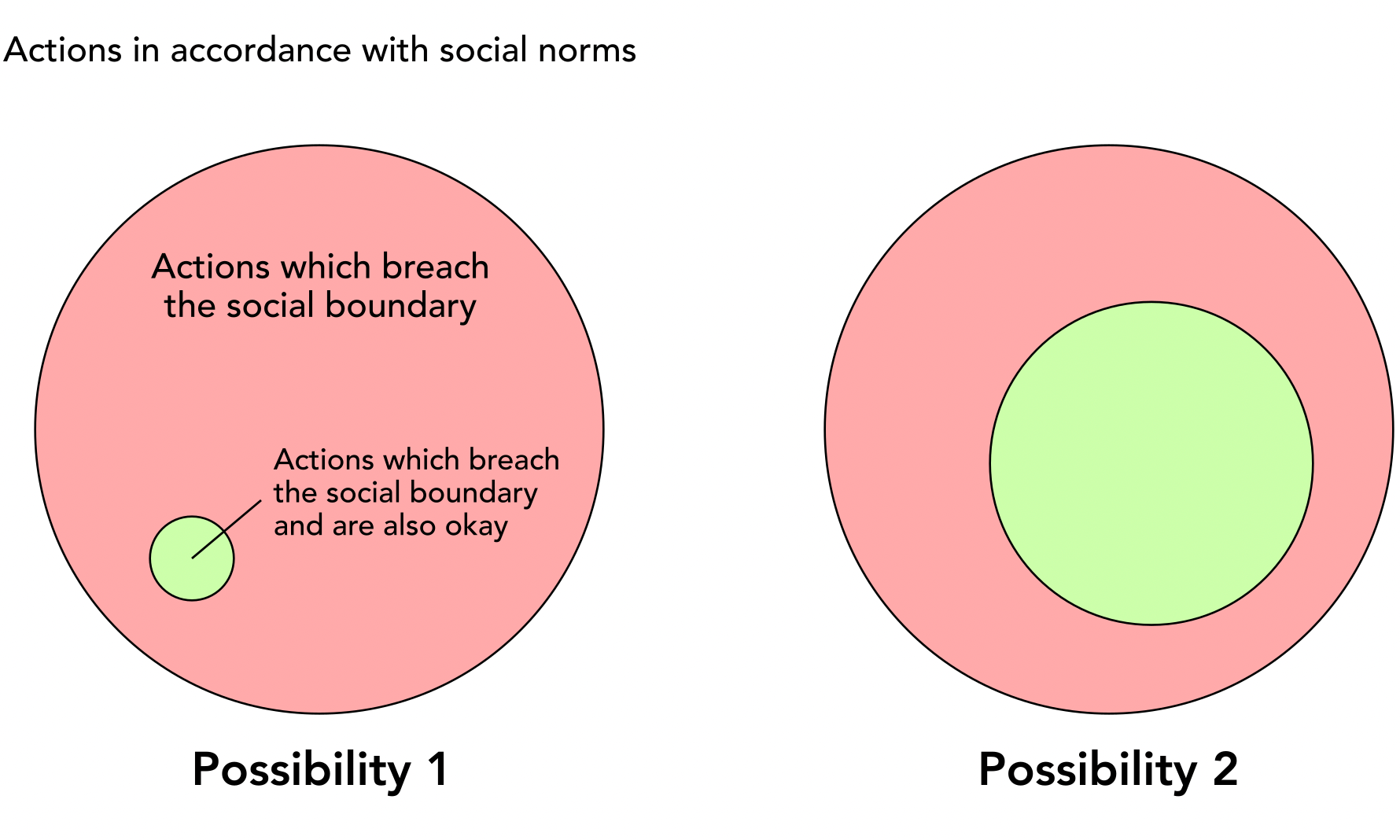
That, then, is the category I'm hoping to talk about: actions which, by the individual’s own self-report, non-pressured and endorsed across time, would be considered benign, despite the fact that they cross one of the lines drawn by society-at-large.
I think this category exists, and is not small—I don't know whether we’re in a world that looks more like Possibility 1 below, or more like Possibility 2, but I don't think the green circle is tiny or non-existent.
Continuing the caveat a little bit:
I predict that nonzero readers will be something-like offended, or perhaps alarmed, that I'm trying to crystallize a concept like “benign boundary violation” at all, since it could e.g. be abused to give cover to those other, worse things.
(Actually, not even “could.” More like “absolutely will be, at a population level.” If the phrase “benign boundary violation” were commonplace, it would definitely be used as a cover, in exactly the same way that “relax, man, it’s just a joke” is used as a cover.)
So why talk about it anyway?
Mainly, because I think that benign boundary violations are super duper important.
(As are jokes! The solution to people abusing the joke-label is not to abolish jokes-as-a-category. People can call something benign when it is not, and often will, for nefarious reasons, but that doesn’t mean that things which are benign don't exist.)
In my own personal experience, benign boundary violations are a crucial part of me feeling safe, and accepted, and part-of-the-group. They are an essential ingredient of my version of close friendship. There is a very strong correlation between:
[periods of my life in which benign boundary violations were absent]
and
[periods of my life in which I was depressed and anxious and lonesome and alienated].
This also seems to me to be true for many other people that I know (more men/male-ish folk than women/female-ish, though also many women in an absolute sense; I would be curious to hear from people in the comments whether others’ impressions differ).
And in my own personal experience, benign boundary violations are an endangered species. They are scarcer now than they were ten years ago, and they were scarcer ten years ago than they were in my childhood (especially in the bluer and lefter parts of our society).
Here is a short list of some benign boundary violations in my own experience (remember, the fact that they are benign for me does not imply they are generally so):
Being punched when a Volkswagen Beetle drives by
Being called “faggot,” affectionately, by my partners, in private
Being pushed into the pool by my fiancé Logan while all my clothes are on (but not my wallet or phone; they surreptitiously checked)
Being pelted with water balloons or suddenly assaulted with pillows or Nerf darts
Having ice dropped down the back of my shirt
Someone jumping out and yelling “BOO!” at me as I emerge from the bathroom
Someone taking and using my objects (desk, exercise equipment, toys, Magic decks, books, clothes) without asking
Someone taking and using small amounts of my money (“Yo, I took a $20 from your desk drawer to pay the pizza guy; he couldn't take a card.”) without asking
Someone coming up behind me and scratching my back or squeezing my shoulders or tousling my hair
Being fed a prank food or made to smell a prank horrible smell
Having an embarrassing story from my past told in front of someone I have a crush on, for the purposes of making me blush in front of that person
Banter/countersignaling (being insulted, rejected, and mocked by and in front of friends)
Being knocked over on a trampoline and then repeatedly bounced such that I can’t find my feet again and keep flailing and floundering on my back
...these are all things which, if someone were to express distress over experiencing, I expect would generally be met with sympathy, solidarity, and support. e.g. if I were to tell a friend that I did not like how my housemate took money out of my desk, it’s quite likely that friend would validate my discomfort, become some level of outraged on my behalf, and say sentences like “yeah, that's called ‘theft’” or “you don't have to put up with that crap.”
In other words, while many of the items on the list above are still something-like-inside-the-Overton-window and wouldn’t necessarily generate active pushback by default, they’re definitely the sort of things that are Officially Off Limits, in the same way as driving 74mph in a 65 zone. If you just joined my team at our white-collar workplace three days ago and I push you into the pool with all your clothes on, you will likely not have a hard time making the label “hostile work environment” stick, should you choose to try.
So they are indeed past the social boundary. But they didn't violate my boundaries.
As far as I can tell, there are at least three major ways in which the actions above fed my immortal soul:
They showed that I was known. By attempting an anticipated-to-be-benign boundary violation (remember, the giver can’t declare it benign, they can only hope), the person who took my money or pushed me into a pool or teasingly insulted me was, at least a little bit, demonstrating that they knew me distinct from their Generic Undifferentiated Cardboard Cutout of a Fellow Society Member. They were making a bet that my line was in a different place than the party line, trying things that they would not try with an unknown human.
They showed that I was trusted. By attempting an anticipated-to-be-benign boundary violation, they implicitly demonstrated that, if it turned out not to be benign, they figured we would be able to handle it, and that our relationship would be able to survive it. There’s a combination of “Duncan isn't made of glass” and “Duncan will not be vindictive or malicious in response, even if this lands poorly” in their estimation of the risk as small-enough-to-be-worth-it.
They gave me actual experiences that I want. Experiences that are disapproved-of by the society at large, experiences which I enjoy and miss. I like banter. I like pranks. I like various things which are not appropriate for the 95th-percentile-vulnerable member of our society, but which are appropriate for me because I am not that person. When the social boundary becomes too broad and its enforcement too strong, what you get is something like “no sports allowed, because some people have glass bones,” and sports are good for people who don't have glass bones.
(Spicy food is good for people who don't have sensitive palates or irritable bowels; loud music is good for people who don't have sensory processing disorders; Reese’s cups are good for people who don't have peanut allergies; etc.)
The problem, of course, is how to get the goods to the people who want and can handle them, without exposing the vulnerable to damage (and, on the meta level, whether to err on the side of caution or incaution, and on the meta-meta level, by how much).
Currently, we seem to be trending both toward wider social boundaries and toward harsher and more explosive intermittent enforcement of those boundaries, which has had the obvious chilling effect on well-intentioned flouting of the nominal rules.
I see various proposals for solving problems like widespread touch deprivation downstream of our personal space boundaries expanding, but they all seem to dismiss a set of costs as not-being-costs, rather than properly weighing and accounting for them.
For example: “Why don’t people just ask you if you’re chill with being hit with water balloons, and then ever after they can hit you with water balloons?”
This is ... kind of a solution. It’s plausible that it will end up being the correct tradeoff, vis-a-vis protecting the vulnerable (make everything explicitly opt-in, rather than having the option to opt out).
But it runs afoul of either 1 or 2 above, depending on the details. If a friend sees that I need a hug, and goes in for one, and then suddenly hesitates, and then asks in mouthwords whether I want to be hugged (at which point I, in the middle of my emotional crisis, have to pause to assemble some kind of verbal response)—
I don’t know. It’s ... not as good. It’s not as good, because suddenly it has turned from “this is a gift” to “do you want this?” and the latter feels much more like Spending Social Points or Making An Active Decision. It’s not as good because suddenly it has turned from “I know you, and am confident and secure in the nature of our relationship” to “I do not know you, and am underconfident and insecure.”
Even in the best of cases, where the would-be hugger is not anxious or afraid or worried that I’ll punish them, and is instead motivated purely by a warmhearted desire to not make my day any worse, it’s still an update in the direction of diminished intimacy.
(Not to mention that a) there are a lot of domains in which just asking is punished anyway, and b) a lot of people are not particularly good at expressing themselves verbally, especially in confusing or stressful or high-uncertainty states, which means that as more of the Required Moves become verbal, more people are simply drummed out of the space.)
And I can summon shoulder advisors who are wailing “why can't we just ask? Why is it so terrible to just ask?” and all I can say is, I’m not saying the cost isn’t worth paying, I’d just like for it to be acknowledged as being a cost, so we can actually try doing the math. We haven’t banned Reese’s from all public spaces, even though this is a hardship for people with peanut allergies, because doing so saves too few at too high a cost.
I noticed that the above veered well into defending the category of benign boundary violations, when really I mostly set out to describe it. So, shifting gears.
When I, personally, attempt what I hope will be a benign boundary violation, what I am doing is leaning on my knowledge of the other person as a unique individual, trusting our relationship to be sufficiently-deeply-rooted in good faith to survive a misstep if I make one, and trying to feed them a nutrient that our society specifically does not offer.
(e.g. our society offers martial arts classes, which you can pay for and put into your weekly schedule. It does not offer friendly surprise attacks.)
And I really, really like it when other people do this with me, as well. When they demonstrate that they know me, when they demonstrate that they trust me, and when they offer me something that is increasingly hard to come by.
That’s three love languages in a single insult. Which is a pretty good rate, and that's pretty much the thesis I wanted to convey.
This is the part where I would like to have suggestions or recommendations or next actions, but I largely don’t. I didn’t anticipate this essay being nearly as fraught as it felt, when I first set out to write it. I thought that I would just say “sometimes it's nice to be pushed into the pool,” and explain my three reasons why, and that would be that.
But my shoulder advisors kept getting really nervous, and so here we are, a million hedges and caveats later. It’s possible I’m wrong, and the other version of this essay would’ve been fine, but it’s interesting to me that I felt scared as I wrote this.
In lieu of “what now?” I’d like to say a little more about one of the obstacles that seems to lie between us and (what seems to me to be) a better world. I don’t have a full model of it, but I can at least gesture in its direction:
I once ran an experimental group house that involved some hierarchical structure, such that we would sometimes e.g. levy $5 fines on one another, for small infractions of agreed-upon rules.
However, the $5 fine was approximately the only consequence that we had in the toolkit. If we were to need something larger, there was a vast, empty lack-of-options until we got all the way up to “I guess you can be kicked out of the experiment?”
And, correspondingly, out of your house. Which was of course far too extreme of a response for any of the situations which actually came up, including several which were Too Big For A Symbolic Five-Dollar Fine.
I sense in this something that rhymes with a known problem among victims of abuse, namely that they are often forced to choose between “get no justice whatsoever” and “throw your partner/parent/pastor into the meat grinder; destroy their life entirely.”
Faced with this choice, many victims of abuse say nothing, and suffer in silence. They would benefit from something a little more in-between—something short of turning their abuser into an absolute pariah, yet more consequential than a stern look.
In my culture, we are also struggling with questions like “how do we strengthen protections for those who are still receiving malignant boundary violations?” and “what do we do for people whose personal boundaries lie outside the current social boundary, such that they are damaged by behavior that the society more or less explicitly permits?”
However, in my culture, we are not attempting to solve those problems by ... hmm ... I do not have a less clumsy metaphor, but ... “pretending nobody speeds”?
Pretending nobody speeds, but also massively increasing the social penalty for people who are unambiguously caught speeding, such that if you are caught speeding a tenth of the population will all start loudly condemning you for going 74 in a 65, how dare you put the very fabric of our society at risk, you should never be hired by any company that uses cars ever again, et cetera.
(And meanwhile the ten percent of people who pop up to defend you do so by saying stuff like “we should drive EVERY car at ONE HUNDRED MILES AN HOUR ALL THE TIME and anyone who doesn't like it is WEAK and probably a PEDOPHILE and DESERVES WHAT THEY GET” which is not support that most of us want.)
When it comes to boundary violations in particular, it seems to me that the middle ground is evaporating, as social media becomes an ever-more important part of our lives and our careers and approximately everybody weighs in on approximately everything that catches our collective attention and the zeitgeist lurches from one scandal to the next (while still ignoring 99.999% of all scandals).
There’s often no response, in other words, until all of a sudden there is a very LARGE response.
In my culture, there are things which should pretty obviously never be done, which are the metaphorical equivalent of going seventy in a school zone. No one thinks they are okay—
(Which actually means that something like 4% of people will declare them to be okay; we round that to zero.)
—and most people would not have an easy time just shrugging them off. Those things get strong punishment with no warnings, just like they do here.
But in my culture, if you do the metaphorical equivalent of going nine over on the highway—
(Which is a thing that a supermajority of people have done at some point or other, and which a substantial fraction of people are actively doing at any given time, and which most people will acknowledge is a little sketchy but basically fine, as long as it’s not compounded by bad weather or tailgating or weaving in and out of traffic or whatever.)
—if you engage in common, everyday behavior which is genuinely hit-or-miss, and it comes out miss, you get the equivalent of a warning or a small fine, not a 99% chance of nothing and a 1% chance of being fired, canceled, and made a pariah. It certainly goes on your record, such that abusers can’t accumulate warnings with impunity, but it's not responded-to with the same weapons that we use to respond to someone going seventy in a school zone.
And as a result, people are a little less creeping and terrified.
(Or, to be more accurate, good and ordinary people are less creeping and terrified, and thus the set of people occasionally going nine over isn’t only populated by [ideological nutjobs] and [sociopaths with no impulse control] who weren’t deterred in the first place.)
It’s the difference between someone ruffling your hair in an unwanted fashion and someone, I don’t know, caressing your stomach. There are genuinely a lot of people out there who would enjoy having their hair spontaneously ruffled, and there are a lot more people who at least wouldn’t mind it. Stomach caresses, not so much.
(And, to be clear: in my culture, it is absolutely the case that if someone ruffles your hair and you say “Do not do that; I do not like that” and they do it again, down comes the hammer. Because at that point, they have committed the much more serious offense of acting in direct contradiction of your expressly stated wishes about your bodily autonomy, which is a bright line in the same fashion as ignoring a “no” or a “stop” during sex.)
But if someone is not a serial abuser on their third strike, they don't have to worry super much about things like “what if I spontaneously ruffle my coworker’s hair and they take it 99th-percentile badly?” They do not have to worry about potentially losing their entire career over it, because someone successfully bailey-and-motte’d it into sexual assault and it blew up on twitter and your company has more important things to spend its social capital on than defending you so they quietly throw you under the bus.
In my culture. Not in this one. In this one, we don’t seem to have very many medium-sized responses left. We have some responses which average out to medium-sized, in that they’re sometimes huge and usually nothing, but that’s not the same thing.
And so sensible people are risking fewer and fewer probably-benign violations of the common-knowledge social boundaries, and thus an ever-greater percentage of the violations that do occur are decidedly not benign, and there’s an accelerating feedback loop and as a result I hardly ever get pushed into swimming pools anymore without signing a waiver first, and signing a waver takes all the nutrients out of the experience.
(And there are also, I suspect, a lot of people with legitimate medium-sized grievances who are going without justice because the only tools they have at their disposal are frowny-face stickers and hand grenades, and the former doesn't suffice and the latter feels like overkill.)
To be clear: yes, a lack of getting pushed into swimming pools is a fairly small thing, compared to actual serious boundary violations. It’s a price worth paying, if it’s genuinely helping—I happily wore a mask during the pandemic because I do indeed believe that small inconveniences are sometimes worth it to protect other people from Very Bad Things.
But I’m not convinced that it actually is helping. I’m not convinced that the drying-up of benign boundary violations is actually a side-effect of a real and ongoing improvement in outcomes for the most vulnerable among us, or a real and ongoing reduction in the amount of predatory behavior taking place. I’m not sure those things are even happening, and if they are, I’m not sure that this is part of why. It feels like pointless waste rather than a useful purchase.
Other conversations which are not quite this one, but which are certainly related, and are welcomed in discussion below:
Okay but how do we strengthen protections for those who are still receiving malignant boundary violations all the time?
What do we do for people whose personal boundaries lie outside the current social boundary, such that they are constantly being violated by behavior that the society does not object to or prevent?
Is it actually possible to build a culture of supported opting-out, such that people could afford to be less intense about first transgressions?
How do you actually distinguish genuinely meant attempts at benign boundary violations from grooming or testing-the-waters or other nefarious things? Can it actually reliably be done, in practice? Can the latter be prevented without necessarily curtailing or extinguishing the former?
Can the goods of benign boundary violations be goal factored and got some other way?
etc.
These are certainly interesting things to think about. The particular types of boundary-crossing that appeal to you (pranks, being bounced on a trampoline and unable to regain your feet as a result, being made to blush in front of a crush) don't really appeal to me in the way they do to you - I think my reaction to those sort of things would be "this person appears to be trying to bond with me, I think, and assuming that's right then I appreciate the effort and expect there's no malice in it, but I do not find it pleasant and would prefer they tried a different way". And accordingly, those sorts of things would not make me feel known or seen. But I could imagine different things, which are socially risky but the people who know me know I would like them, and being known in that way would feel nice. No examples jump to mind, but in principle I'm on board and I expect if I thought for a while I could come up with some.
What I felt like sharing, though, was that it sounds like your framework seems to implicitly assume that boundaries are relatively stable (context-dependent and often complicated, but typically stable over time?) and I've found at least a few examples where the things I am comfortable with, particularly in terms of physical touch, have changed over the years. When I was young I was fairly isolated and any physical touch was rare, and as a result my nervous system reacted strongly to it. I distinctly remember a cousin of mine, who is very extroverted, who came up and gave me an energetic hug I was not expecting, and I jumped what felt like a foot and made a loud noise indicating displeasure. Her response was to laugh and forever after try to surprise-hug me. This was a case of "she is doing something I do not like and would prefer she stop doing, she knows this, and seems to be doing it just to get a reaction out of me". But, that impression was incorrect, she wasn't just poking me for fun, and we are now close friends in a way we wouldn't have become if she hadn't pushed for that to happen. I am now much more comfortable with physical touch from friends, and being pushed in the way she did is part of why. Although, it's a small part, it's more a case of a longer-term process of learning that the world is safer than I thought.
So, I think "benign pushing boundaries" should include something like that - although it's really hard to figure out under what circumstances it should be accepted rather than dissuaded, because even my thoughts and boundaries at the time wouldn't have been good guides. Plausibly this is a case where behaviour which turned out OK should have been punished on principle. I'd at least like to offer the possibility for consideration, that in some cases a situation where society's boundaries are on the inside of an individual's boundaries, might point at a situation where adjustment on the part of the individual could be beneficial.
Another thought I had is that a lot of your examples sound like play. And the thing that differentiates play from not-play (say, play-fighting from actual fighting) is that all participants are monitoring each other for damage, not intending to cause any, and backing off and apologizing if ever any occurs. For example, if someone was bouncing you on the trampoline and you started to feel nauseous, they would notice and stop, and if their attempt to embarrass you in front of a crush was causing you genuine distress because today was a bad day for that behaviour for whatever reason, again, they'd notice and stop. Pushing boundaries in a playful way where all people involved are attempting to be in tune with how the others are feeling and push things a bit but not too far, can obviously be a bonding activity.
Holy fuck this is semiotic gold