
Hopelessness
(shortpost)

Author’s note: you probably shouldn’t even read this one; I wrote it more to extract it from my own veins than because anyone out there actually needs to see it.
In my long, meandering essay Truth or Dare, I talked about a person (pseudonymized as Mitchell) who had developed a strongly negative opinion of me, which consistently colored his interpretations of my behavior. Because Mitchell knew that I was a dick, he knew that when I said X or Y or Z, I must be doing it manipulatively, or disingenuously, or with some sort of ulterior motive.
The problem was, it was projection all the way down. When I tried to find the original source of his belief that I was a dick, all I could dig up was a long history of [ambiguous interactions interpreted uncharitably], with the justification for any given interpretation being all the other interpretations. Mitchell knew that I must have been secretly being a dick in June because back in April he confirmation-biased that I was being secretly a dick because back in February he confirmation-biased that I was being a dick because last November he confirmation-biased that I was being a dick because the summer before he confirmation-biased that I was being a dick because…
(You get the picture.)
There’s something about this pattern that reminds me of trying to argue with a certain type of religious person. There’s something like a self-reinforcing network of beliefs—I start out by (say) getting them to acknowledge that the actual personal history of their individual faith strongly implies that if they’d been born in Saudi Arabia, they would be a devout Muslim, and not a Christian at all.
And they nod, and there’s a flicker of unease, and I try to build upon that flicker of unease by (say) moving on to talk about the Council of Nicaea, or the patently cobbled-together nature of Judeo-Christian mythology, or perhaps the concept of falsifiability, or the overwhelming evidence in favor of things like evolution and the age of the earth being four and a half billion years and the absolute lack of any pattern that would indicate the viability of prayer or superior health or wealth or morality among the faithful…
…but it’s not like there are a dozen pillars holding up their faith, and if I show them that each of those pillars is false one by one, then voilà, mission accomplished.
Instead, what happens is, I show them that one pillar is fake and crumbling, and maybe they even acknowledge that that pillar is fake and crumbling, and I move on to two or three other pillars, but when I turn back, the first one has already repaired itself. The argument doesn’t properly accumulate. Yeah, sure, I showed that the actual reason they believe in Christianity is just that their parents and community told them to, and if they’d grown up in Saudi Arabia they’d believe in Islam instead, but whatever, they still have the correct faith anyway, I guess they lucked out or something, because [a bunch of other reasons that are also overturnable, but if I don’t somehow overturn them literally all at once then they just keep resurrecting one another as soon as my back is turned].
I run into something like this pattern a lot, and when I do, what I feel is hopeless.
It’s not that it literally cannot be broken. It’s that doing so requires something close to the literal maximum effort I am capable of producing, sustained across a large period of time, and even then the odds of success feel like a coin toss.
In part, it’s a coin toss because the truth of the matter at hand is not even the most relevant factor, most of the time. If I actually sat down with Mitchell, to be like “look, I think you straight-up misjudged me, like, fourteen times in a row, and I’d like to exhaustively demonstrate to you how every single one of those times I was actually behaving nobly, I think I can do it, I have the actual evidence,” I’d pretty quickly run into one of those lovely little Kafkatraps:
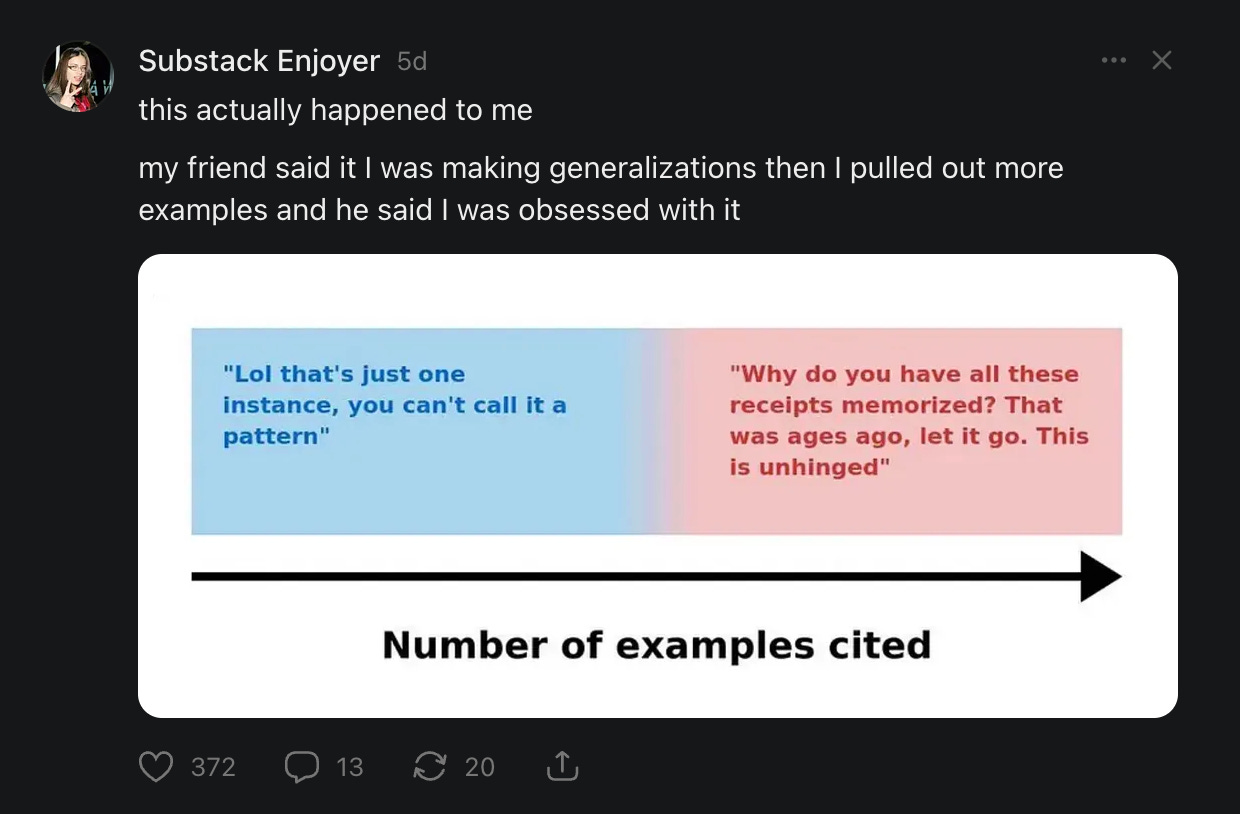
Just as the Christian isn’t actually there to be deconverted, but is instead listening with an air of (extremely finite) patient tolerance, so too is Mitchell not actually interested in finding out that he’s wrong.
He doesn’t even have to be malevolent, or intellectually dishonest. He’s just … already sure. He has like fourteen separate instances that all point in the same direction, after all! What’s even the point in entertaining a hypothesis as wildly unlikely as the one that I’m proffering?

Even if I get Mitchell to consider something like three different run-ins in a row, and demonstrate that all three of them were the sort of thing where I don’t deserve any sort of blame or censure, this doesn’t fix anything. It often makes it worse, actually—
“Okay, sure, those times you weren’t being a dick, but that just makes me even more confident that you were being a dick the other times, because otherwise where did this very strong feeling that you’re a dick come from?”

The reason this whole structure is on my mind now, and I’m unable to sleep at three in the goddamn morning (or whatever time it is, I’m too scared to look), is that I’m currently feeling hopeless. I am currently trapped under the net of a bullshit, false narrative that is (as far as I can tell) not even the slightest bit interested in discovering that it’s false.

And—as with Christianity, as with Mitchell—the problem is not that I can’t exhaustively demonstrate that this is, in fact, false.
(I can.)
(It’s just plain false.)
(To those of you who are shocked that I would say something so ridiculously, patently absurd when Jesus is obviously the son of God; everybody knows that: it’s really, actually false, in an insanely Kafkaesque fashion; when people actually produce lists of times when I have allegedly “turned on” various people—
(Which they usually do not bother to do in the first place, because it’s so self-evidently true that they don’t need to justify it, any more than most Christians feel the need to actually provide any reason for believing in Christianity.)
—usually like a full third of the list is people that I spent literal years giving chance after chance after chance after chance, long after the-type-of-person-who’s-accusing me-of-turning-on-people would themselves have cut their losses and burned the bridge behind them. And as for the other two-thirds—man, don’t even bother, they’re not interested in your “story.” 🙄)
The exhaustion, in situations like these, comes from the fact that I don’t just have to win this fight.
It wouldn’t even be enough if I won all of the dozens of fights, because of the cyclical self-repair thing. I could have the receipts on literally 100% of them and the miasma would still stick to me.
The problem is that, in order to even get to a place where I’m allowed to start presenting evidence on the dozens of fights (and have it taken seriously), I first have to win a meta fight to move the other person to a position of like maybe being willing to consider that the entire edifice is deeply unfair and based on illusions and projections and confirmation bias and monkeys uncritically reinforcing one another’s made-up stories.
Which is a hard thing to do, in the face of the confidence and dismissiveness of a person who’s got dozens of examples lined up, in their conception of things. You can get a devout Christian to listen politely, but it’s not easy to get them to actually listen, with a genuinely open mind—to think through the question afresh, be willing to reassess an entire self-reinforcing memeplex, to unwind dozens or hundreds of instances of rehearsing the gestalt and be suspicious of the well-worn grooves of their own established narrative. It’s like asking someone to seriously consider that the sky is green.
(Or more aptly, to seriously consider that maybe those two colors that they are absolutely certain are the same are in fact different, which is much harder to convince someone to do when they’re surrounded by people who all share the same color-blindness, and are constantly reassuring each other back and forth that nope, those are definitely the same shade, don’t fall prey to the seductive whispers of atheists and satanists, the more convincing they sound the more you know they’re trying to pull one over on you, actually…)
If I do somehow muster (in spite of my despair) and succeed at effortfully extracting some sort of tentative, begrudging admission of the mere possibility, drawing heavily on whatever warmth and goodwill might exist between me and the other person, and whatever respect they might have for my morals and my intellect—
(Which is often not much, given that these situations usually involve being in the doghouse to begin with.)
—I will still have only just begun. I will have run a half-marathon just to get to the starting line—the place where the fair fight even can happen, in principle.
And it’s in that arena that I’ll subsequently have to do something like make a hundred correct moves all in a row, without any mistakes, because if I phrase something clumsily or accidentally overstate something or get some checkable claim slightly off, then boom: the default skepticism and the original viewpoint are just waiting to landslide their way back in, see, I knew it, he was full of shit, my dozens of examples weren’t all downstream of a single magnetic field of bias pulling all the data suspiciously in line—
(Three seconds in to explaining how the very first example isn’t what it looks like, and my interlocutor shoots back with “but you see how it is” because they did not, in fact, actually sustainably shift their brain into a state of genuine dispassionate neutrality; they claimed that they had and probably believed that they had but in fact their actions are indistinguishable from the actions of someone who is looking for me to be wrong, trying to poke holes in what I’m saying, believes they already know the answer and is suspicious of what seems to them like any attempt to move away from that answer.)
—and it’s just, like.
Yeah.
Go ahead and give up, buddy. You’re not going to win this one; the truth of the matter was never the crux; you already lost in the social and emotional realms and those are the realms where people decide to lynch you.
(There’s nothing quite so demoralizing as knowing that you are in the right (and could even prove it) and that you are going to lose anyway. That there simply is no viable path, in practice, to deconverting the Christian, even though their god does not, in fact, exist.)
Hopeless.

Sad to say I've been the person with the self-reinforcing network of largely-false beliefs (with regard to https://aella.substack.com/p/the-other-porn-land/comment/240855567). And yeah, the thing that finally broke me out of it was *not* in fact a direct counter-argument against the belief that [person-I-barely-knew] was my One True Love or against a major swath of the associated memeplex I had built up around it. The thing that broke me out of it was reading hpmor and the sequences, which taught me *general* good practices of epistemology while (mostly) refraining from arguing against the specific false beliefs I had, such that I could eventually apply those practices to my false beliefs and realize their falsity on my own. Sadly, I suspect even Eliezer would have failed if he'd tried to change past-me's mind by directly challenging the false beliefs I had.
The reasons for beliefs aren't always about the beliefs being true. (Which means showing that they are false won't cause the person believing them to change their position.)
...you knew this already, right?