

I cannot play the violin at all.
Most humans on earth and in history share this trait with me.
If you were to give me a few hours with a competent teacher, I could probably get to the point where I can play the violin a little. But it would only technically be “playing.” It would only bear the barest resemblance to what people mean when they say “so-and-so plays the violin!”
I’d probably be one of these guys:
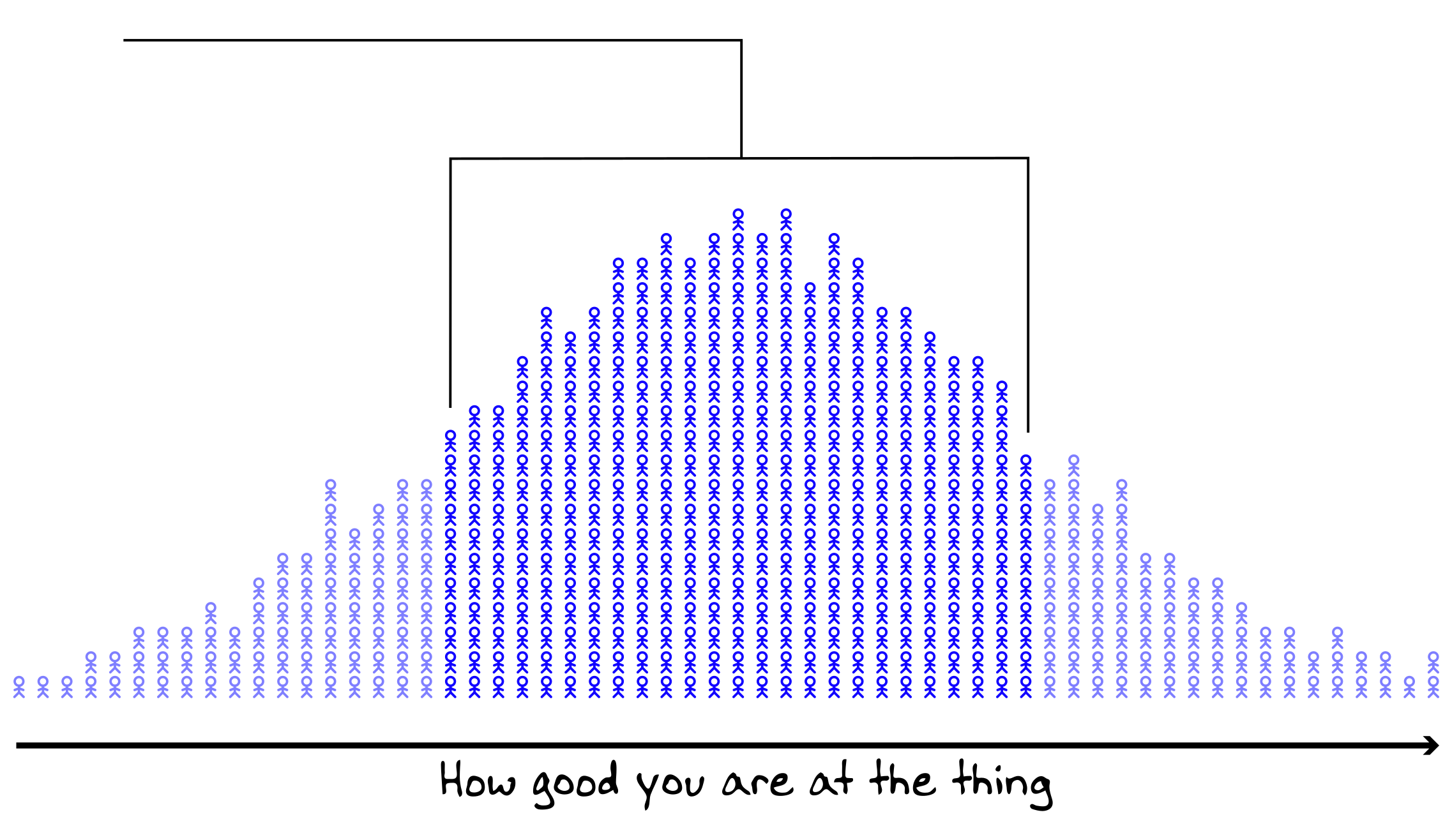
…since most people are. I have no reason to predict that I’d be unusually good or bad at it.
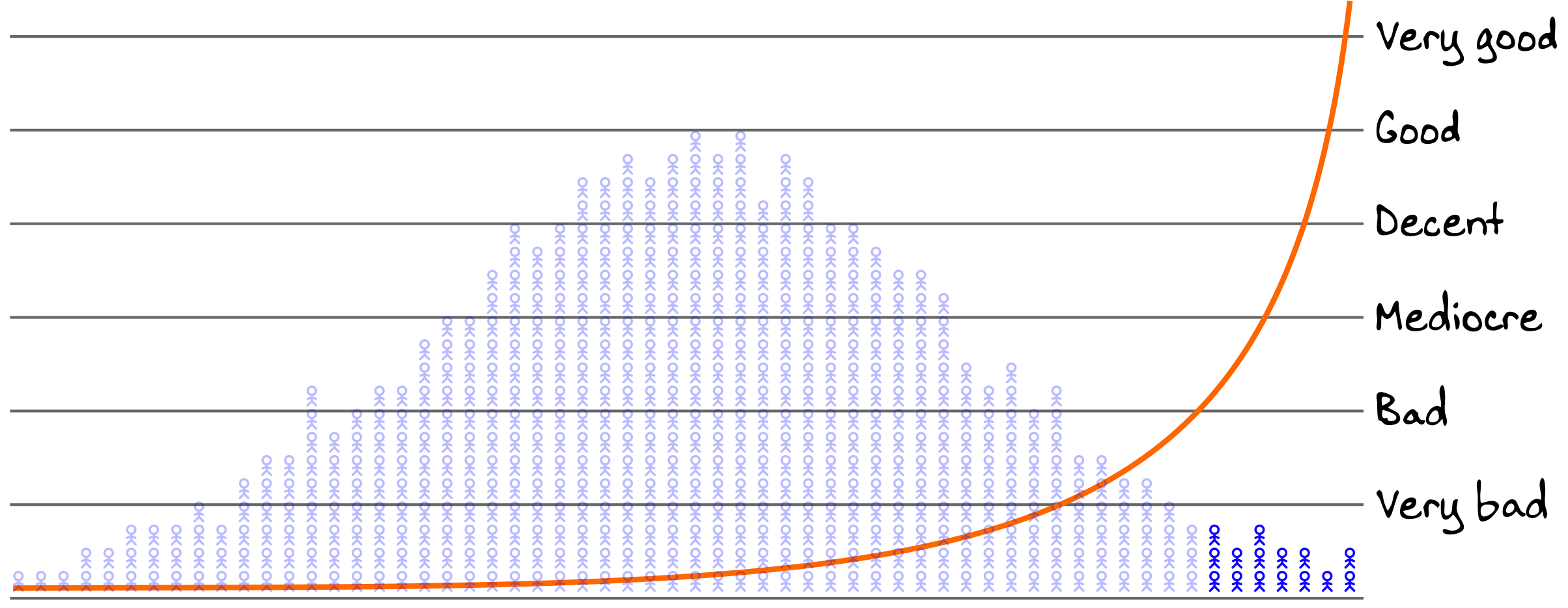
But here’s the thing about playing the violin. It’s sort of … logarithmically distributed?
By which I mean, if you rank everyone on Earth from one to eight billion, according to their skill at the violin, then being #4,000,000,000 does not mean that you’re half as good as the best violinist on the planet. Not even close.
Being at the bottom of the list is bad.
Being at the middle of the list is bad.
Being three-quarters of the way up the list is bad.
Being nine-tenths of the way up the list is bad.
Once you hit something like 95% of the way up the list, it’s like okay, maybe you’re starting to approach middle school orchestra levels of tolerable/worth listening to.
(Uh, asterisk: that doesn’t mean you shouldn’t do it, for like joy and fun and fulfillment and because you’re allowed to do whatever you want! You’re not supposed to be good at the violin—or at least, I am not supposing it. Part of what I’m pointing at here is we’re almost all terrible; stop worrying about being terrible.)
Skill in the violin is clustered on the right side of the graph, such that you have to already be extremely unusual in order for your violin playing to be pleasant at all, and you have to be extremely extremely unusual in order for it to be notably good.
Here’s the unfortunate kicker: this is true of, like … a lot of things.
The things that brought it to mind and caused me to write this essay were the skills of:
Explaining things
Securing cheerful cooperation from children
(i.e. “teaching” and “parenting”)
But it’s true for a lot more than teaching and parenting. It’s true for writing. It’s true for reading. It’s true for nunchakus, and parkour, and driving, and cooking, and chess, and theoretical physics, and introspection, and graphic design.
Given skill X, the overwhelming majority of people are overwhelmingly bad at it. This is true even if you limit yourself only to people who’ve actually put time into the pursuit; among veteran teachers most teachers are awful, and among veteran parents most parents are deeply incompetent.
(Most parents and teachers, in my experience, are actively counterproductive in a literal majority of the actions they take; things would be better most of the time if instead of doing what they were doing, they did nothing at all.)
We muddle through anyway, but it’s important (according to me) to keep a few relevant implications in mind, as you move through the world:
Experience doesn’t imply skill
Common levels of skill are not necessarily good in any absolute sense
The ceiling of competence on most skills is as-far-away-from-average as the ceiling of violin playing is from the average violin player.
It’s sort of uncomfortable to think about it and even more awkward to talk about it, but in fact the best teachers and parents and artists and conversationalists and middle managers and therapists and editors and Magic: the Gathering players are hundreds or sometimes even thousands of times better than the central member of their class.
(“What do you even mean by ‘hundreds or thousands of times better’ in a domain like teaching or parenting or therapy?” Well, these are sort of crude ways to think about it, but: could solve a problem within the domain in a hundredth or a thousandth of the time it would take a novice to solve the same problem equally well; or, if given a list of all possible problems within the domain, could successfully solve a hundred or a thousand times as many of them, to a given standard of competence; or, if put side by side with the novice in a hundred or a thousand situations, would do unambiguously better than the novice on literally all of them.)
For whatever reason, people get real tangled up about stuff like creativity or skill at lovemaking or whatever, and don’t like acknowledging that this extreme right-tail effect exists. People don’t (usually) feel threatened by “so-and-so is a thousand times better than me at the violin” the way they seem to feel threatened by “so-and-so is a thousand times better than me at being a good spouse.”
But unfortunately, the flinching-away doesn’t make it not true. It just makes it harder to think about, and talk about, and look at with curiosity, and improve. The anxiety and self-consciousness reinforce the status quo; insisting that you’re amazing at the violin, actually, and in fact it’s not even possible for someone to be that much better at the violin, how arrogant, how presumptuous, fuck them for even implying that your violin playing is kind of like listening to cats having sex in an alley—
(I mean, you shouldn’t actually tell someone their violin playing is like listening to cats having sex in an alley, most of the time. Most of the time, there are nicer and more constructive ways to offer the critical feedback, assuming that it’s appropriate to be giving critical feedback at all, cf. the part where the vast majority of people are fucking awful at providing feedback, which is a skill that includes knowing when to not do it.)
You’re probably not good at playing the violin, and neither is the next guy.
This is fine—
(It’s not a reason to not do it anyway! Find joy!)
—and it’s better to be able to take a deep breath and let that truth in than to wander the world wrongly believing that you’re surrounded by (and exuding) competence in all sorts of domains.
You’re probably not.
But the world keeps turning anyway, so maybe we don’t have to pretend quite so hard. Maybe we can accept the reality we’re already living.

Two quick thoughts come to mind:
1) Feels like it is not a bell but instead an exponential curve with a long tail of mostly nothing.
2) A Story:
We discovered our kid was a dancer in high school - they had intense focus so we found the best teachers outside of high-school to stoke the flame.
The high-school dance recital was peppered with dancers of various skill levels. One was a student (call them 'X') who (it was clear) LOVE-LOVE-LOVED dancing and we heard had been training as a dancer since they were tiny. That dancer moved around the stage with technically proficiency. Our kid threw themselves across the stage with power - physically expressing the complex emotional pain they were going through as a neurodivergent in a high pressure environment. The crowd erupted.
After the recital the parents of X walked over to us and we had a complex interaction with them after we answered their question of how long our kid had been dancing (as they had never seen our kid at the local dance schools in the decade plus they had been steadily fostering X's growth).
"Three years now?"
They expressed a heart-breaking mix of congratulation tinged with sorrow that my partner and I have never forgotten.
Reminds me of two friends I'm watching regularly. One is a gaming streamer and the other one is a chess Grandmaster, coaches the German national chess team and was Magnus Carlsen's second during several world championships (those are the guys helping prepare a chess player). The gamer bet the chess Grandmaster that when they play a thousand matches, he will at least win one of them. The Grandmaster told him no chance. They're at match 156 at the moment.