
Noise
(shortpost)

One of the most valuable two-minute stretches of my entire life was the moment when my engineer friend told me that real-life performance curves are messy.
We’re used to Econ 101 textbooks talking about supply and demand that show smooth increases in price leading to smooth increases in revenue, until the price gets too high and customers start dropping off. Curves that look like this:
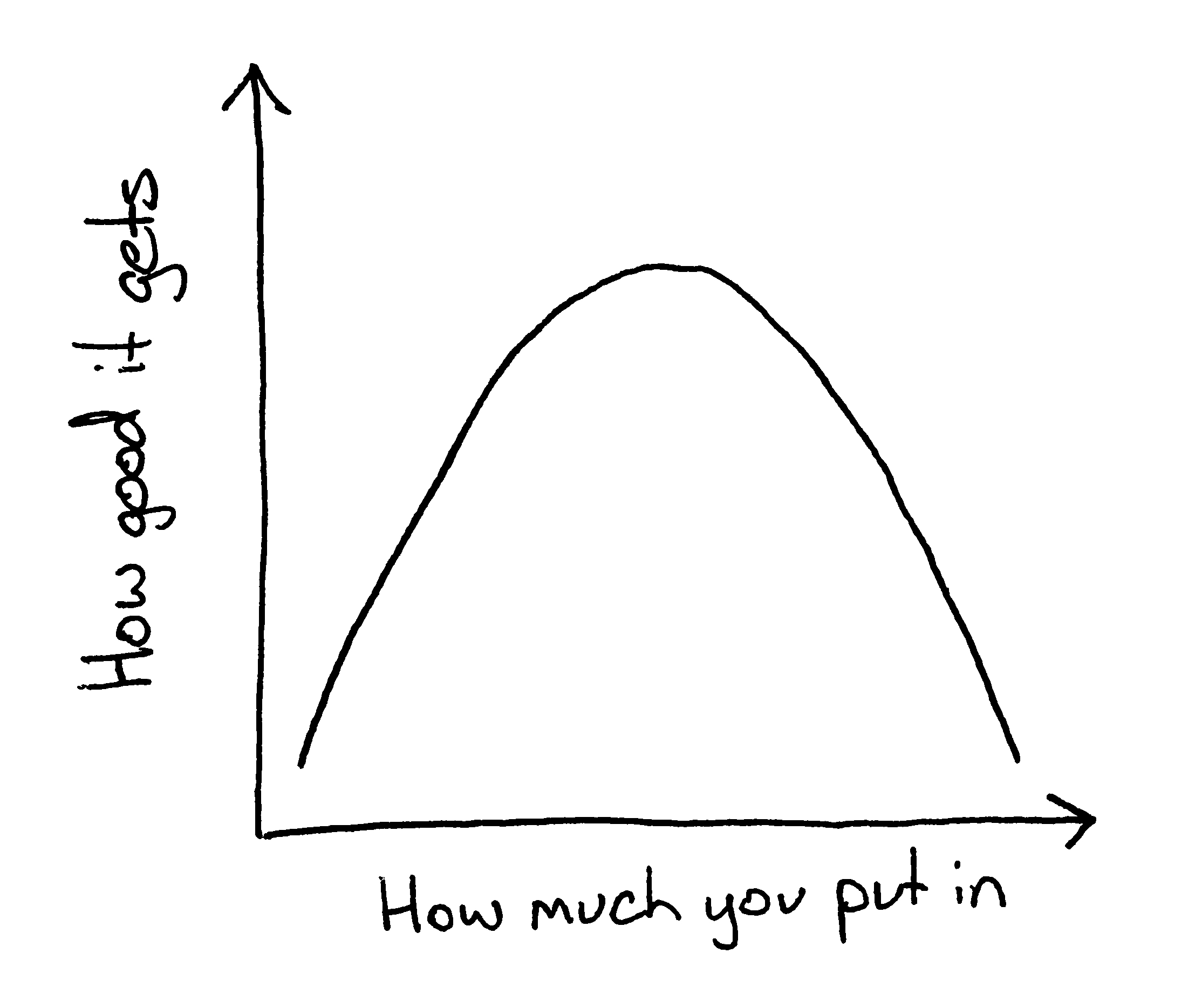
…except (said my engineer friend, convincingly and with the weight of years of frustration audible in their voice) it doesn’t actually work like that at all, in practice.
In practice (they said), what you get looks more like this:
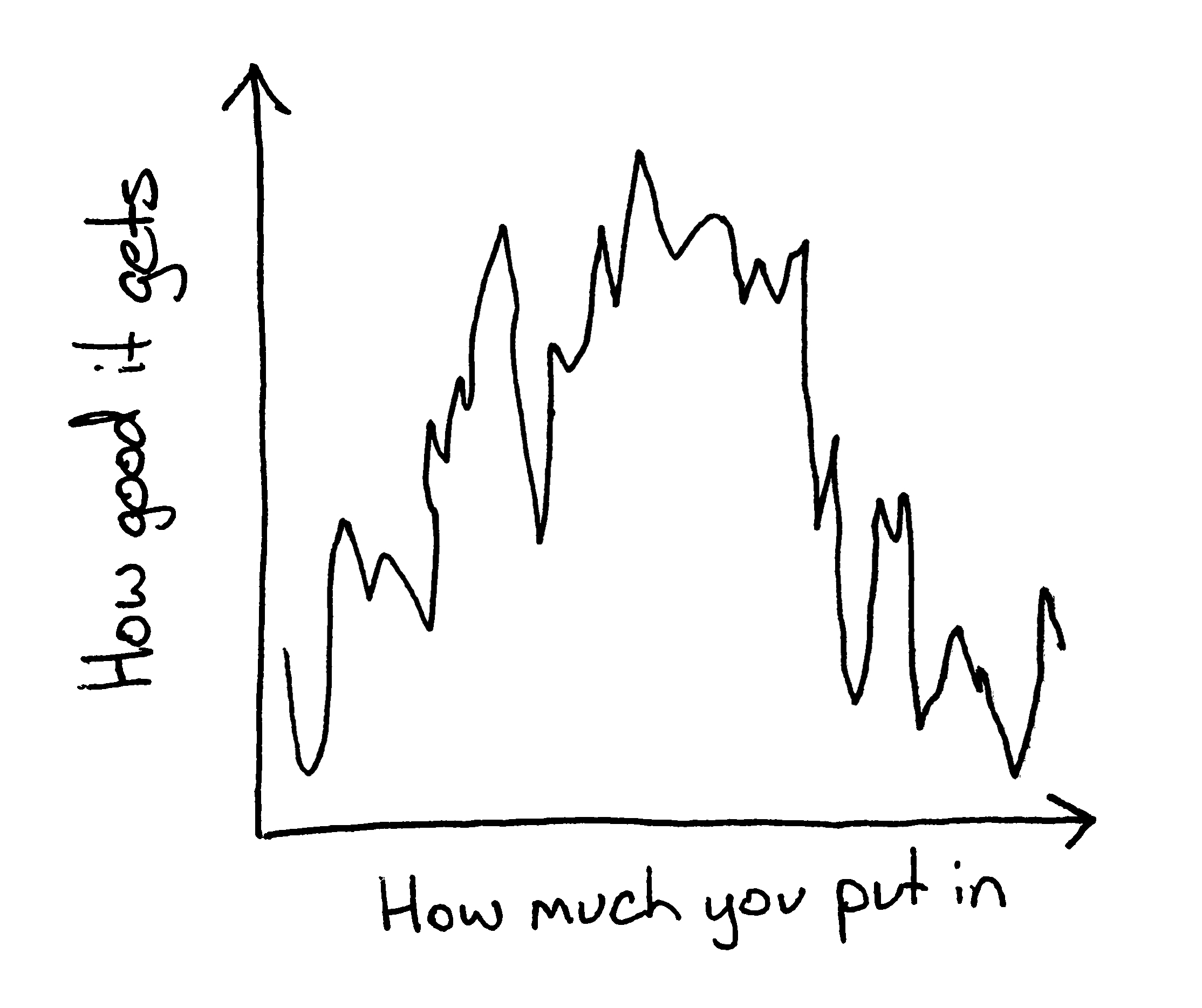
…and that’s if you have perfect information. There are just too many other forces at play, for any of the interesting and valuable questions; things never really vary on a single variable; it’s always a messy multidimensional space and when you collapse it down to two dimensions what you get is incomprehensible chaos.
(Indeed, even this curve is simpler than many real-life performance curves, which can e.g. have multiple real peaks where this one is basically normal.)
And we don’t usually have perfect information. We can’t usually sample all that many points. We skip around on the graph more-or-less at random, most of the time, which means that the above reality might look to us like this:
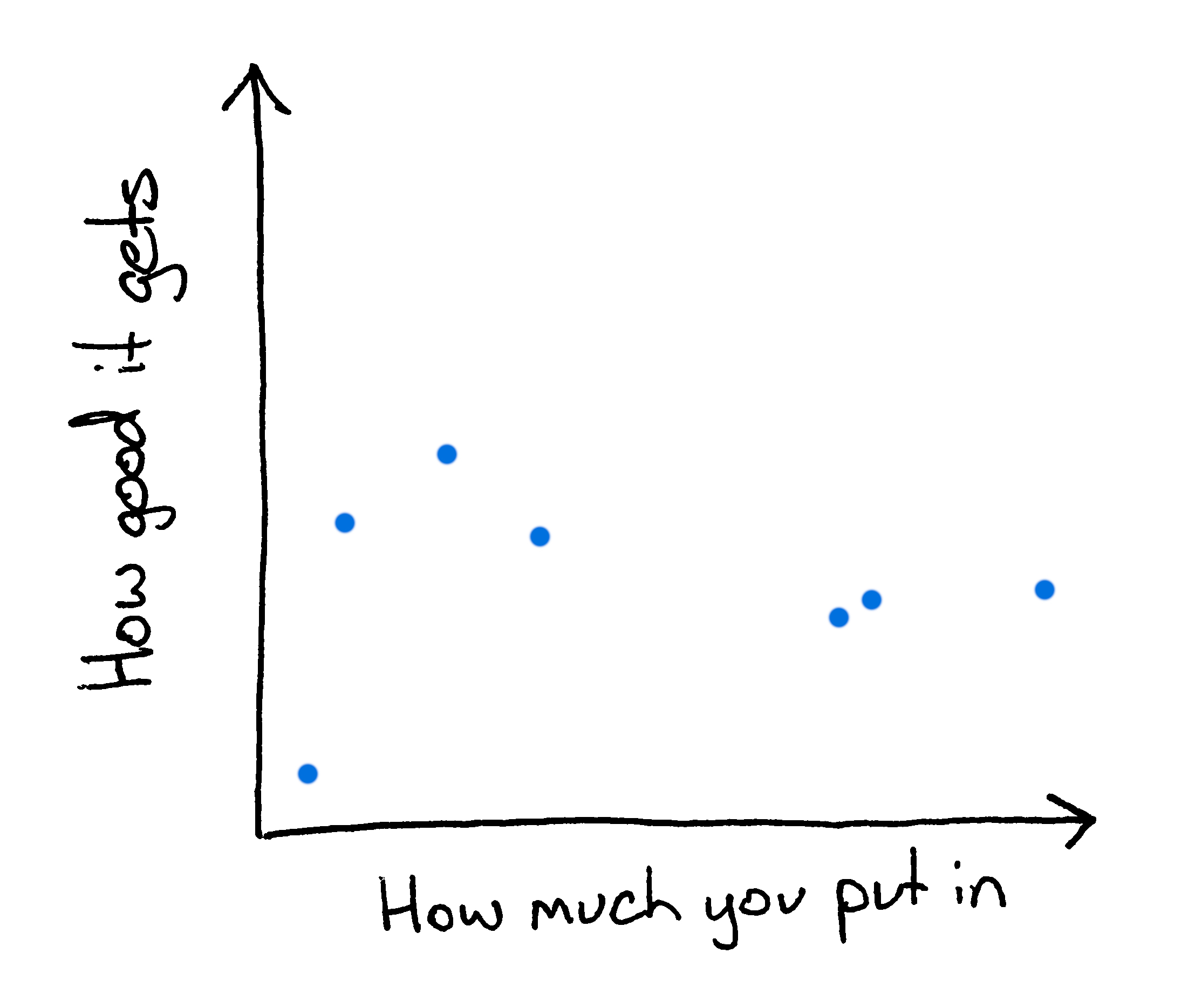
…which certainly does not encourage one to aim for the actual (unknown) sweet spot.
(To be clear, all of those blue dots do, in fact, lie on the messy curve above.)
Or maybe after trying a few things, the situation looks to us like this:
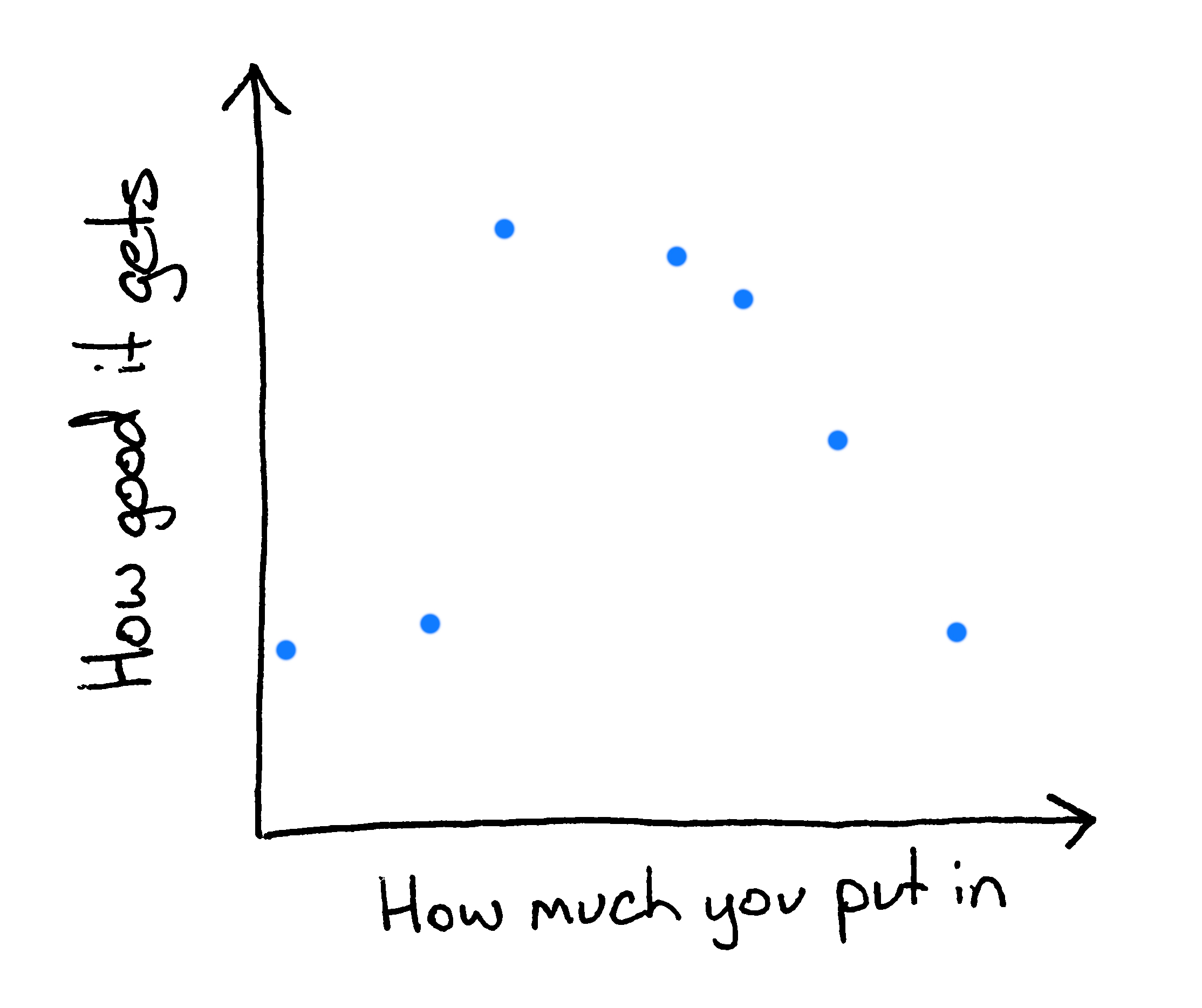
…which kinda does locate the sweet spot, but in a confusing and uncertain sort of way where if you try sliding just a little bit away from the highest blue dot you might end up at this orange dot:
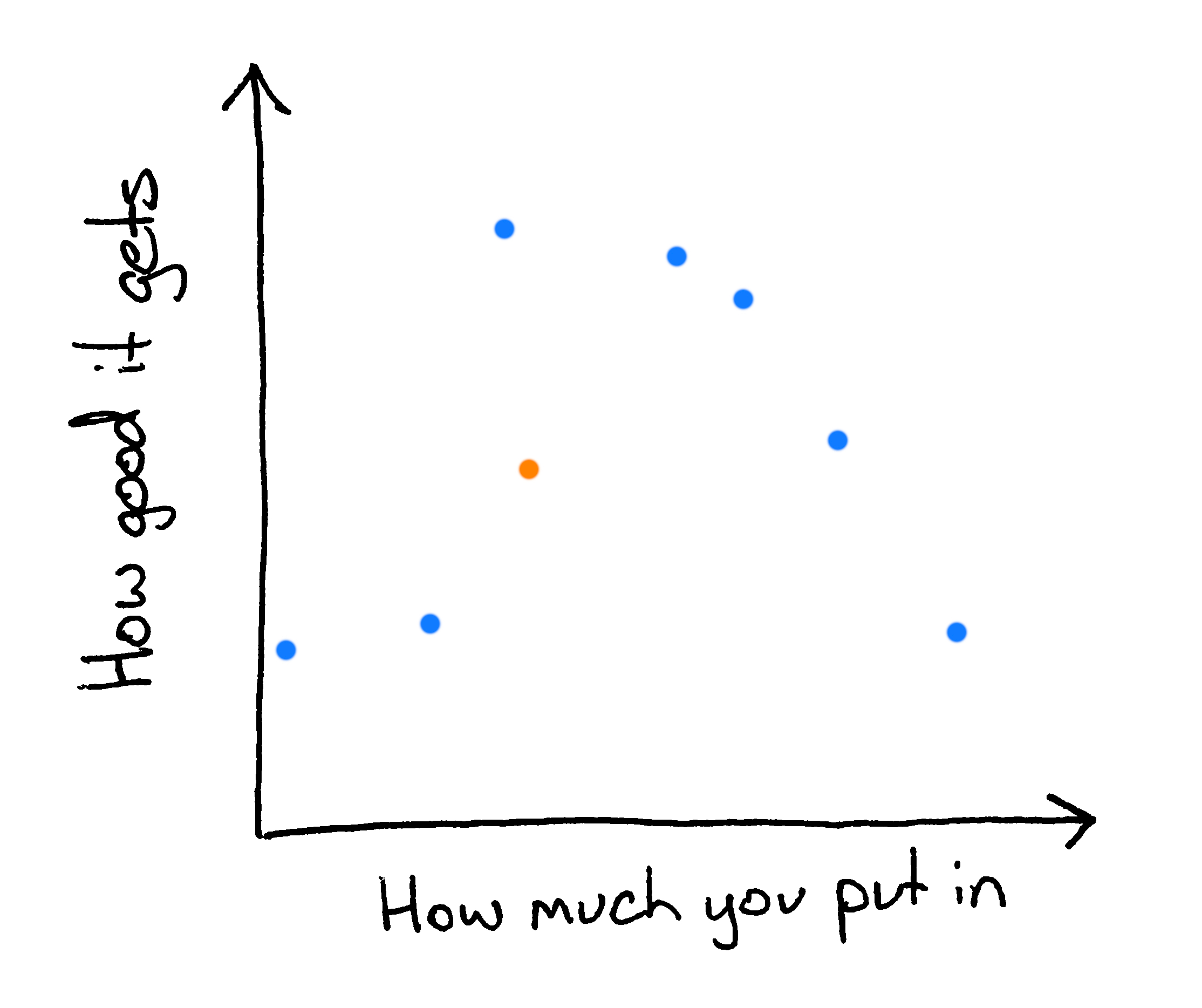
“Okay, well, that’s fine, just … don’t quit experimenting, at that point” is easy advice, but when what you’re struggling with is something like persistent health or energy problems, or the quality of your relationship with your significant other, or some other fraught, expensive, high-stakes endeavor, it’s not always easy to “just keep going,” and that’s before you factor in the possibility that the curve itself is changing—
(e.g. as you age, or as your relationship matures and shifts)
—and you can’t necessarily even go back.
The tyranny of Ravenclaw/Magic: the Gathering blue is something like the obligation to just keep looking, just keep investigating, the true best answer is out there, actually, you really can find it, if you give up before you find it you’re some kind of lazy or dumb or not really trying.
But the reality of the situation is (as Hufflepuff/Magic: the Gathering green would have it) often actually “this search is exhausting and you would have to go far, far beyond the limits of your endurance to find the one true best answer to even just one question, and that best answer may not even be all that much better than the answers you’ve already found.”
I sort of already knew green-ish exhortations like “be gentle with yourself,” and had heard sazen like “reality is messy” and “there’s always more to the story” and “life isn’t simple” and so on and so forth.
But (for me, at least) none of it made it sink in as well as my engineer friend’s hard-earned scoff, at the idea that we could just try adding a little more and see what happens. A weight of responsibility lifted off of my shoulders, that day—a weight that my entire education had intentionally placed there. I’d spent my life being told, not just that I could figure it out (if I tried hard enough), but furthermore that I had to, and that throwing up my hands in confusion and defeat was a sign of weakness and inadequacy.
It can be.
But god damn, sometimes shit is just really really complicated.
Knowing that made it a whole lot easier, emotionally, to settle for being pretty high up atop a pretty high hill, even if in principle there might be much much higher hills out there.
There are worse places to end up, too.
This is something I try to convey to people regularly, in many areas, and I appreciate now also having this 2-min piece I can also try to throw at the wall and see whether it sticks :)