

Note: some of these links go out to LessWrong, where I used to post a lot of content. I haven’t mirrored all of those old essays, but all of my new essays show up here, so this is still the right place to subscribe for future stuff.
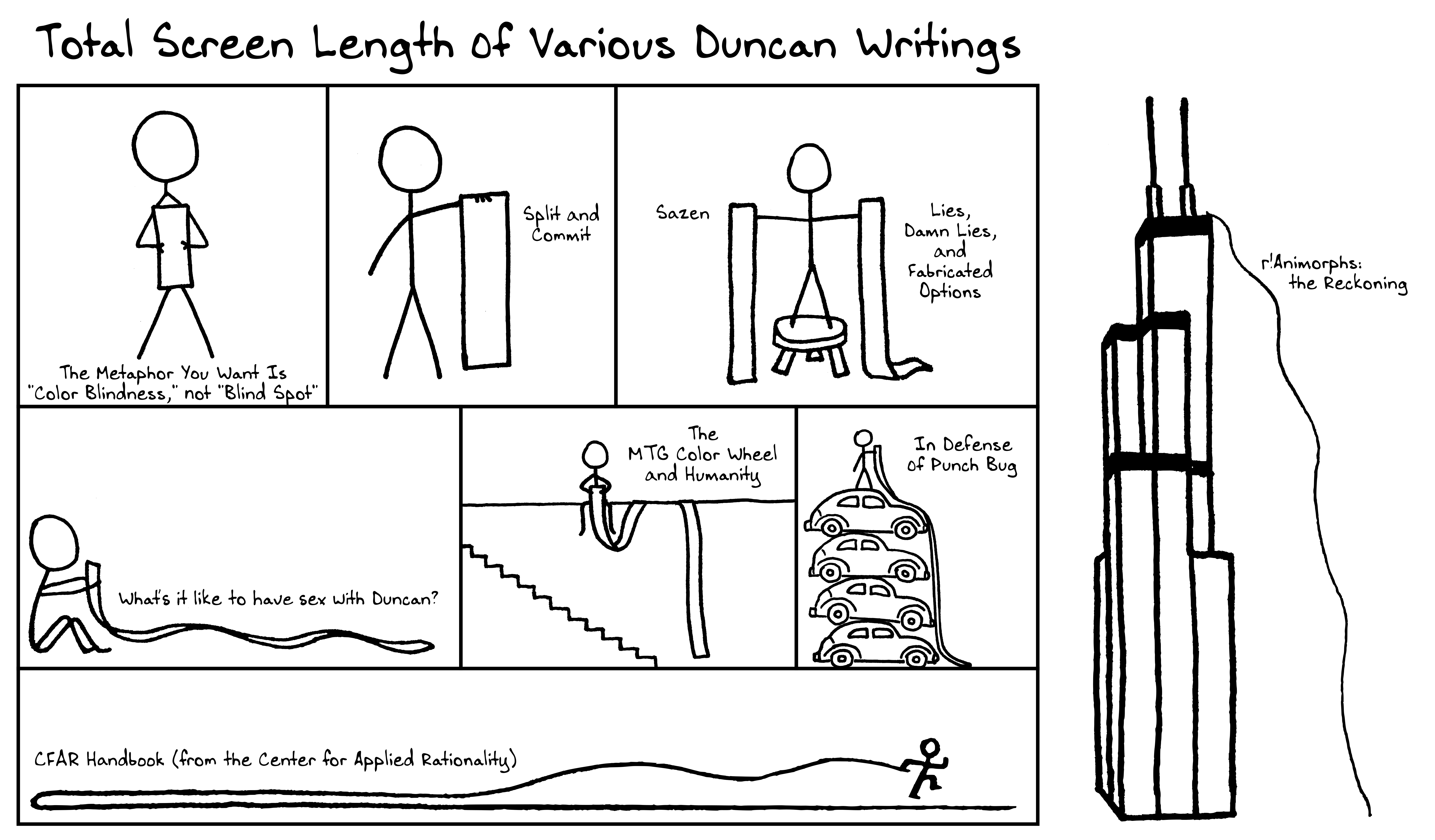
Core rationality stuff that isn’t here on Substack:
The CFAR Handbook. This is a thorough introduction to the models and techniques of applied rationality, in the form of a handbook that originally accompanied CFAR’s 4.5 day retreat workshops.
Basics of Rationalist Discourse. Ten simple rules for better collaborative, truth-oriented communication, with expansion and explanation.
For seeing the world more clearly:
Lies, Damn Lies, and Fabricated Options. This is an essay that helps people to stop skipping over dour, uninspiring (but real) options, in favor of sparkly, exciting (but impossible/fake) options, because that usually results in accidentally defaulting to terrible (avoidable) options.
The metaphor you want is “color blindness,” not “blind spot.” One of my most underrated essays, about how blind spots are not usually in one place.
Social Dark Matter explores the ways in which we’re drastically misunderstanding things that people have a strong incentive to hide (both their nature and their frequency).
White Chocolate Is Not Chocolate is about how the words and concepts we use end up confusing and misleading us.
It’s Not What It Looks Like is an essay about how your first guess about what something probably is ought to be different from your final conclusion about what it definitely is.
You Are The Deer In The Subway is about noticing the ways in which the modern world is poorly designed for, and hostile to, humans (especially from an evolutionary and psychological perspective).
Concentration of Force is about how tiny-but-timely applications of force can be way more influential than large-but-diffuse ones.
Kodo and Din is about noticing which bits of information are actually evidence, and which tell you nothing at all.
The MTG Color Wheel (and Humanity) is about using the color wheel of the card game Magic: the Gathering as a lens for understanding people, groups, cultures, and stories.
Cup-Stacking Skills (Or, Reflexive Involuntary Mental Motions) is about understanding the way that certain mental motions can happen almost unbelievably quickly, and can be outside of our control.
“We” is Killing Us is about the ways in which identifying with other humans causes us to do very bad things.
You Are Awash In Superstimuli is mostly explained by the title; you probably don’t even need to read it. You might want to read Encitification, though. (They’re two looks at the same object.)
Listen, you’re probably not good at the violin. is about how most people are bad at most things and true skill in a given domain is both a) rare and b) often staggeringly greater than what the average practitioner has to offer.
Straightforward how-tos for specific, useful skills and practices:
How to Write Like Duncan Sabien contains the One Weird Trick that is approximately responsible for me being the writer I am today.
Shoulder Advisors 101 is about taking advantage of the fact that your brain is built to simulate how other monkeys will respond to stuff.
Focusing, for skeptics is an introduction to (the part of) Gendlin’s Focusing (that I found most useful). It’s a method for getting a better handle on confusing emotions, and figuring out what’s really bothering you.
Chocolate tasting, for skeptics is an introduction to the art of attentive tasting in general, and why it might be fun for you.
Split and Commit is about the sanity-inducing ritual that I do most frequently/reflexively and think is among the most important for people to learn.
Reneging Prosocially is about how to minimize the damage of breaking your agreements.
How To: A Workshop (Or Anything) is a case study in using something like expectation management to make things happen.
An autist's introduction to Circling is, um. An autist’s introduction to Circling. (Which is a specific, weird kind of conversational practice.)
Counting Up vs Counting Down is a tutorial on splitting apart two different evaluatory frameworks that most people conflate.
Practical philosophy:
Meadow Theory is an essay on how to think about the responsibility you have toward less perceptive and less experienced and less knowledgeable individuals under your care.
The EDUC Omnibus is a set of three essays on some counterintuitive ways to approach classroom education (that went very very well for my middle school students).
Moderating LessWrong is about a theory of moderation for a culture of collaborative truth-seeking.
Hubris & Control is about what goes wrong when our wants and drives are applied outside of the contexts that originally kept them in check.
Make More Grayspaces is about how to insulate your subculture from people who would destroy it, without making it inaccessible to newcomers and beginners and people who just need time and help to learn.
Killing the Red Queen is about how certain kinds of competition are ruining everything, and how (maybe) we can fix it.
On communicating clearly:
Sazen is about the difference between saying a version of a thought that’s sufficient to communicate it to someone with all of your experience and background, and saying a version of that thought that could actually convey it to a total novice.
Overconfidence is Deceit is about ways that people use emphasis socially rather than to convey accurate information about their beliefs.
Ruling Out Everything Else argues that you don’t locate concepts only by saying what they are, but also by very clearly saying what they aren’t.
Sapir-Whorf for Rationalists is about why inventing new words and jargon is super duper cool, actually.
Various Heresies, Or, On building a culture of robustness:
In Defense of Punch Bug is probably my most-read and also most-controversial essay of all time. It’s about how punch bug is good and not evil and bad.
Benign Boundary Violations is about how transgressions against social norms that don’t actually hurt people can be nourishing, not bad (and not merely neutral).
Invalidating Imaginary Injury is about the ways in which we think ourselves into genuine pain and damage, and how we might reinforce and support one another less in making that particular mistake.
Truth or Dare is a meditation on the large cultural divide between people whose experience of the world is one of safety and security and trustworthiness, and people whose experience of the world is one of danger and uncertainty and betrayal.
Trauma and Grooming is an essay aimed at convincing you that your concept of “grooming” is probably confused and not actually helping prevent abuse.
Other social dynamics:
Thresholding is about the damage that happens when people keep doing things just shy of the level that would garner a response or punishment.
Common Knowledge & Miasma explores the ways in which people change their behavior in response to the difference between everybody knowing X, everybody knowing that everybody knows X, and everybody knowing that everybody knows that everybody knows X.
Exposure to Lizardman is Lethal is about the dangers of not having any barrier between you and the craziest or most hostile people out there.
Killing Socrates is a meditation on the balance between creation and critique, and how a little bit of Socrates-spirit being good doesn’t imply that a lot of it is better.
Dragon Army Retrospective is a set of lessons learned during my attempt at running an experimental intentional community.
Digging In Your Heels is about why people sometimes bafflingly refuse to do the obvious good thing, and how you can avoid that mistake yourself.
Notice That You’ve Taken Two Steps is about how people gradually find themselves radicalized and extreme-ified, and how to do something different instead.
Obligated to Respond is about the pressures that are created by public commentary, and how anticipating those pressures deters people from making things that would be commented on in the first place.
Artificial intelligence and existential risk:
Why Against Death is a gentle primer on why it’s actually really good not to die, for people who are confused about that.
Deadly by Default is my attempt to give a simple, 101 introduction to why artificial intelligence poses an imminent extinction risk.
Strategic Convergence Among Relatively Intelligent Antagonists is an essay on what intelligence is, and concretely how having more of it leads to victory over opponents who have less of it.
Takeover Not Required is about a particular common misunderstanding in people’s imagination of AI takeover.
On being a stranger in a strange land:
You Don’t Exist, Duncan is a raw, experimental essay about feeling invalidated.
On Puberty, Identity, and Sex lays out the issues I have with coercive, non-consensual puberty, and how it interferes with people’s values and agency. (Followup: On Growing Up)
What’s It Like To Have Sex With Duncan? is an essay based on me asking a dozen of my former partners that exact question.
Review: Conor Moreton’s “Civilization & Cooperation” is an introduction to the culture of the imaginary land of Agor, and how people in Agor think about what society even is.
Three of my best Facebook essays talks about dealing with society’s gymnophobia, a formative childhood experience involving a violent school bus, and why most people scare me.
Fiction:
Pass is my finished original literary novel, currently going online one chapter per week as of September 2026. It’s about superheroes, parkour, and the nature of friendship. The main characters are two seventh graders.
r!Animorphs: The Reckoning is my 650,000-word fanfic based on the Animorphs book series from the late ‘90’s and early 2000’s. It is ️🔥.
Chapter 9 — Soldier is set within the “missing year” in the book Ender’s Game, between when Ender was a soldier in Rat Army and when he became the commander of Dragon Army.
Delayed Gratification is a one-shot Star Wars fanfic, set during the early days of Anakin Skywalker’s training under Obi-Wan Kenobi.
Waste is a one-shot original, about a promising young child who is honored with a visit from the God-Emperor.

(Again: this is just the upper ~half; if you’re a completionist or are otherwise interested in going deeper, look here, LessWrong and archiveofourown.)
A reminder, just in case you got distracted by all the cool links along the way:
I’d really love it if you identified a few friends/family members/colleagues, and a few Duncan essays that might be a good fit for those people, and forwarded them along. Going from one hundred to two hundred paid subscribers would be a significant improvement to my life, and also I kinda think the stuff I have to say is interesting and useful, actually 😅.
Sent three posts to three friends who I think are not yet subscribed to your blog.
Thanks for making it easy to do. I copy-pasted the description of each article.
I'd like to pay more for my subscription, but want to do it monthly instead of yearly. Is there a way to up my monthly payment?