

I’m in the middle of NaNoWriMo, which is taking up most of my writing spoons, and my actual job is taking up much of the rest, so I’m writing this one as if I were talking to a copy of myself, i.e. omitting many of the usual hedges and caveats and declaring lots of things without actually backing them up or heading off all of the possible misunderstandings. Also I’m sick. Reader beware.
Content warning: non-erotic discussion of anal sex beginning in section IV.
Related reading: Aella’s Chattel Childhood
I.
One of the more common definitions of trauma is that it is the result of having an experience that is discordant with your story of yourself and your life.
Something happens to you that conflicts with your sense of self, or your sense of how-things-should-be, and you end up stuck and hurting until you can either:
a) correct what went wrong, in a way that restores balance under your preexisting worldview (i.e. secure justice)
b) process it. Do new sense-making. Establish a new understanding of yourself and the world and your place in it that can include what happened, instead of what-happened being somehow Too Big For The Narrative.
Under this definition: at any given moment in time, there are things that would be traumatic for you, and things that would not. Right now, you have a psychology that includes a narrative and an understanding of yourself and the world, and while that narrative and that understanding shift constantly, in this exact moment there are things you are capable of digesting and metabolizing, and there are things you are not, which would traumatize you.
This essay is about how that changes, over time.
II.
Another perhaps-too-cute way to say the above is: it’s the meaning that makes the meaning. What an event means, to us, is inextricably tied up with the meaning we assign to it.
As a toy example: people who drink non-alcoholic drinks while believing that the drinks are alcoholic usually end up behaving drunkenly, and people who drink alcohol while believing they aren’t behave (mostly) soberly. People who take a psychedelic like LSD or psilocybin or ayahuasca with the explicit intention of Having A Transformative Experience™ often do, while people who are exposed to psychedelics accidentally often just have a really weird day and think that they’re mildly sick.
This is not an absolute. Rates of PTSD in elite military groups such as the Marine Corps and the Navy Seals are actually quite high, even though those groups do a lot of meaning-making to minimize the traumatic impact of the experiences they go through, and to transmute those experiences into something self-affirming and empowering and epic. There are limits to what you can achieve, with narrativemancy.
But explicit sense-making seems, to me, to be something in the neighborhood of half of the puzzle of trauma. It seems to me that one’s narrative around a potentially traumatic event has the potential to cut the damage in half (or even more), or to double or triple or 10x the damage. I suspect that Marines and Seals are less traumatized, overall, than a randomly selected human subjected to the same experiences would be—that the rates of PTSD would be much worse without their training and mystique.
(And the filtering for the-type-of-person-who-even-wants-that-sort-of-thing.)
When ““traumatic”” things happen, to a person who was fully expecting them and braced for them and unsurprised by them and taking them in stride, there is still damage. But the damage is greatly reduced.
(c.f. Dave Chappelle’s “The only difference between a poor black person and a poor white person is that a poor white person feels like it’s not supposed to be happening to them.”)
Pain is pain, and damage is damage; suffering is something our beliefs and expectations have a weird amount of influence over.
III.
In my absurdly long Animorphs fanfic, one of the alien species that I reimagined was the Pemalites, a pacifistic dog-loving race who just want everything to be fun and friendly and for everyone to be happy all the time.
In my reimagining, part of what the Pemalites were optimizing for is the absence of jarring—being whiplashed, jerked around, unpleasantly surprised. The Pemalites had a deep and powerful preference for smooth curves, gentle transitions, gradual change.
This feels very, very related to trauma, to me. It feels like this sort of being-jerked-around is an ingredient of trauma—violent, sudden course changes, expecting that you were going to be going in that direction and then suddenly BOOM now you are going in this direction, with no time to prepare.
(I’m autistic. Autistic people are often more sensitive to this kind of jarring than the average human, so it’s tempting to conclude “no, Duncan, you’re just weird, this doesn’t generalize.” But I’m also an unusually effective teacher and a major chunk of what I do when I’m leading a group is managing expectations and smoothing transitions, and this is nigh-universally positively received and something I get thanks and compliments for all the time, including from normal people. So I think it really is that autistics are simply more sensitive, and not that jarring course changes are ~harmless for less-weird people. Optimizing for a Pemalite results in an experience that normal humans find unusually pleasant and refreshing.)
I think that this dovetails with the idea that our narratives influence what we find traumatic, and how traumatic we find it. Narratives are stretchy, but slow—a big part of why we object to deus ex machina in our stories is because the deus comes out of nowhere, and that breaks our ability to integrate it.
IV. The part where I discuss anal sex.
Speaking of stretchy, but slow.
(Notice how, even if this is jarring, it’s less jarring than it would have been if I had omitted the CW at the beginning.)
I’m not sure if you’ve ever engaged in receptive anal sex, and even if you have, your experience may have been different from mine. But in general, I think that anal sex fits pretty well, and is a pretty good metaphor for/instance of the overall pattern I’m trying to establish above.
Namely: right this very second, if someone were to try to, er, dive right in, this would almost certainly be painful and injurious and traumatic for you.
But also, there does exist a(n at least theoretical) smooth transition that could move you from the state of [nope, unpossible] to [yay, hooray] without ever crossing the line into pain and damage.
What is painful and damaging right now is not necessarily painful and damaging if you put in the work to ensure that the transition is smooth and gradual and adequate.
(To be clear, this is true both of the physical action of loosening the muscles and of the mental/emotional/psychological stuff. There are plenty of people for whom the very idea of engaging in receptive anal sex is upsetting or disgusting or scary, and also a supermajority of those people could eventually get to a place of exploring this domain happily and healthily and enthusiastically, if they chose to.)
(Also, to reiterate: there are some things that are just damaging, period, regardless of your narrative around them; there probably also exist smooth narrative transitions that result in suicide or becoming a murderer or stoically accepting horrible horrible abuse; the point here isn’t to say that all things which you can be brought to accept are good, it’s just to point out that you can in fact be brought to a state of acceptance about many things, including many which absolutely Do Not Fit within today’s version of you.)
Content warning: generic, non-detailed discussion of rape beginning in section VIII.
V. Green, Yellow, Red
A digression.
It’s common in certain kink circles for people to check in with their partners by asking their partner for their “color.”
Green means “I’m happy. This is going well. Everything is within-bounds—to the extent that I’m in pain or discomfort it is pain or discomfort that I want.”
Yellow means “We’re pushing the boundaries. Something about this might not be sustainable. I’m okay, but it would probably be better if we changed something.”
Red means “This is not okay. We need to stop.”

An easy mistake for a Hufflepuff to make is to think ah, okay, we should always stay green, then.
The reason I think this is a mistake is that you can’t actually know what something is like until you try it.
In other words, every new experience is, to some extent, a leap of faith. You can often get a pretty decent sense, up front, about how a new experience will land with you, by comparing it to experiences you’ve already had. If you like rollercoasters, you will probably like bungee jumping.
But you can’t actually know what a given section of the territory is like, until you go stand in it.
(Or, in other words: if you want to guarantee that you stay in the green territory at all times, you are as a result only ever going to take very tiny steps, and progress toward anything truly new is going to be very, very slow.)
Some parts of the territory are something like “twenty steps away” from where you currently stand—would require a string of transitional experiences. Long, long before I ever engaged in receptive anal sex, I put a finger up there, and putting a finger up there was hard. I spent literal months habituating to the idea, based off of my exposure to smut in which characters I identified with seemed to really enjoy it. I was pretty sure nothing would go wrong if it turned out I didn’t like it. It was private, it was secret, no one else had to know. And still I bailed on two separate days where I started out fully intending to go through with it. On the day I finally did it, I spent almost an hour in the bathroom beforehand, taking deep breaths, working up the courage. It was a big deal for me. I was yellow the whole time.
(Now, that territory is green! This is how comfort zone expansion works: you hang out in the yellow and if nothing bad happens your color starts to change. More on this in the next section.)
As a less risqué example: if memory serves, the biggest stack of cinderblocks I ever broke with my forearm was six cinderblocks. When I joined my Tae Kwon Do academy at the age of twelve, I didn’t have “breaking six cinderblocks” on my mental radar at all. I neither wanted to, nor was able to. I was guided down the path of being able to safely enjoy the act of smashing concrete with my body.
VI. Exposure therapy
Exposure therapy is a process for taking things that are red, and making them yellow or green. It’s often used for e.g. debilitating irrational phobias. The process looks like this:
You take a person who’s extremely afraid of spiders, and you sit them down at a table, and you say “okay, that piece of paper on the table actually has a photograph of a spider on the other side.”
Then you check their anxiety, out of ten.
“Nine,” they say.
“Great. Let’s just sit here for a minute or two. Let me know if your anxiety drops to eight.”
When it does, session over.
Come back the next day. “Seven.”
“Okay, now what happens if you think about flipping the picture over?”
“Nine.”
“Again, let’s sit here for a bit.”
You continue to let the patient viscerally experience the absence of disaster, as you gradually increase their exposure to the previously-terrifying stimulus. You let their nervous system learn, via direct experience, that nothing awful happens—to drop from red alert to yellow.
This requires going slowly. If you just toss a bucket of spiders at them, this teaches them that terrible things will happen, actually. But if you let them achieve (relative) calm, dropping from red to yellow, then you can take another small step, and another, and another. Pictures of spiders become videos of spiders. Videos become an actual spider, in a container, covered by a sheet that we don’t actually have to remove, today, take your time, there is no rush, we can leave it covered up for now, just focus on your breathing.
Exposure therapy is extremely powerful. It can take people with crippling agoraphobia and, in many cases, restore them to completely normal functioning, allowing them to reclaim their lives.
It can also do things like dull the fears of a germaphobe so thoroughly that the germaphobe can lick a public toilet seat while staying green the whole time.
(This seems bad!)
VII. Wtf even is “grooming”
In section IV, I put the words “if they chose to” in bold. I did that because I think those words are important.
I think there are ways of gradually bringing a person around to the idea of receptive anal sex that are unpressured and self-affirming and empowering and which involve treating the person (and their beliefs and values) with dignity and respect every step of the way (even as you might be changing or undermining those values).
I think there are also ways of bringing a person around to the idea of receptive anal sex that are manipulative and coercive and which rob the other person of their agency and which (even if they are cleverly calibrated to avoid eliciting an actual complaint) are clearly contra that person’s coherent extrapolated volition.
(Coherent extrapolated volition is a technical term that can be approximated as something like “what you would like and want and endorse if you spent thousands of years becoming smarter and refining your understanding and exploring what is possible.” Think about the values that you had when you were six, and compare them to the values you have now, which you hopefully think are wiser and more refined; your CEV is, uh, several more steps down that road.)
In other words: you can get people to accept, and even want, things that they very much do not want, today, by showing them the truth (that those things are in fact good, and worth the costs required to access them)…
…or you can get people to accept and want things by brainwashing them.
The problem is, these two processes often look very, very similar, in practice.
Once, while investigating a possible risk to some of the students under my care, I got the chance to spend a few hours chatting with a forensic psychologist with something like twenty years of experience working directly with child molesters and their victims.
(I suppose by now it’s more like thirty years.)
It was a fascinating conversation, and I’ve carried it with me ever since. The things I learned during it have been in the background of many of my essays over the years.
One piece of it that I haven’t written about before: when I brought up the word “grooming,” this highly experienced professional literally scoffed—like, actually made an audible sound of disgust and dismissal. I double-clicked, and she explained that, from her perspective, as a healer, the word was worse than useless, because it was confusion-inducing. It caused people to lump together behaviors that were harmful with behaviors that were harmless or even actively good, making it harder for people to see the actual axes of consequence.
This conversation was over ten years ago, so this quote is very, very approximate, but:
I mean, imagine a healthy relationship, romantic or platonic. At the start, you don’t know each other at all! You’re not intimate, physically or otherwise. And then you try things. Gently. Slowly. You test the waters, and you see what the other person likes and is receptive to. You don’t just leap into the deep end. You start with a touch on the arm. Once touches on the arm feel safe, you escalate to a warm hand on their back. And if a given touch results in a flinch, you back off, but you don’t necessarily never try that touch again. A hug. Touseling their hair. That’s how you build intimacy. Pathologizing the gradual accumulation of intimacy doesn’t help anyone.
I think back to a romantic partner of my own, someone who had never been with a man before me. I think about the slow escalation of our physical intimacy—led by me, the more experienced and comfortable partner—and how indeed, from the outside, it could easily have looked like “grooming,” even though I think it was entirely good and healthy.
(Because it involved me gently stretching the green territory. Probing carefully into yellow, slowly and patiently; allowing that yellow to settle; allowing that yellow to acquire a tinge of green, start to feel normal and fine, and then gently pushing again, a little further this time.)
Okay, you might say, but that was an age-appropriate partner; the problem is when someone grooms a partner who’s too young or otherwise disempowered and can’t say no.
Except that doesn’t seem quite right to me, either.
To be absolutely clear: I do think that the-thing-the-word-grooming-is-gesturing-at is real. It seems extremely obvious to me that there are, in fact, people who weaponize habituation—who take advantage of the fact that humans habituate to bad/harmful things almost as easily as they habituate to good/healthy things.
But I think you can’t tell that habituation techniques are being weaponized, just from the mere fact that habituation techniques are in play. This is the mistake that Dr. Haverty was pointing at—that people were seeing harm in any habituation, because some habituation was used for harm.
(The term-of-art for this mistake is the representativeness heuristic.)
I think that my Tae Kwon Do master habituated me to the idea of breaking cinderblocks with my forearm. He brought me along—me, a trusting child.
Okay, you might say, but that’s not physical intimacy.
I mean … it is, though?
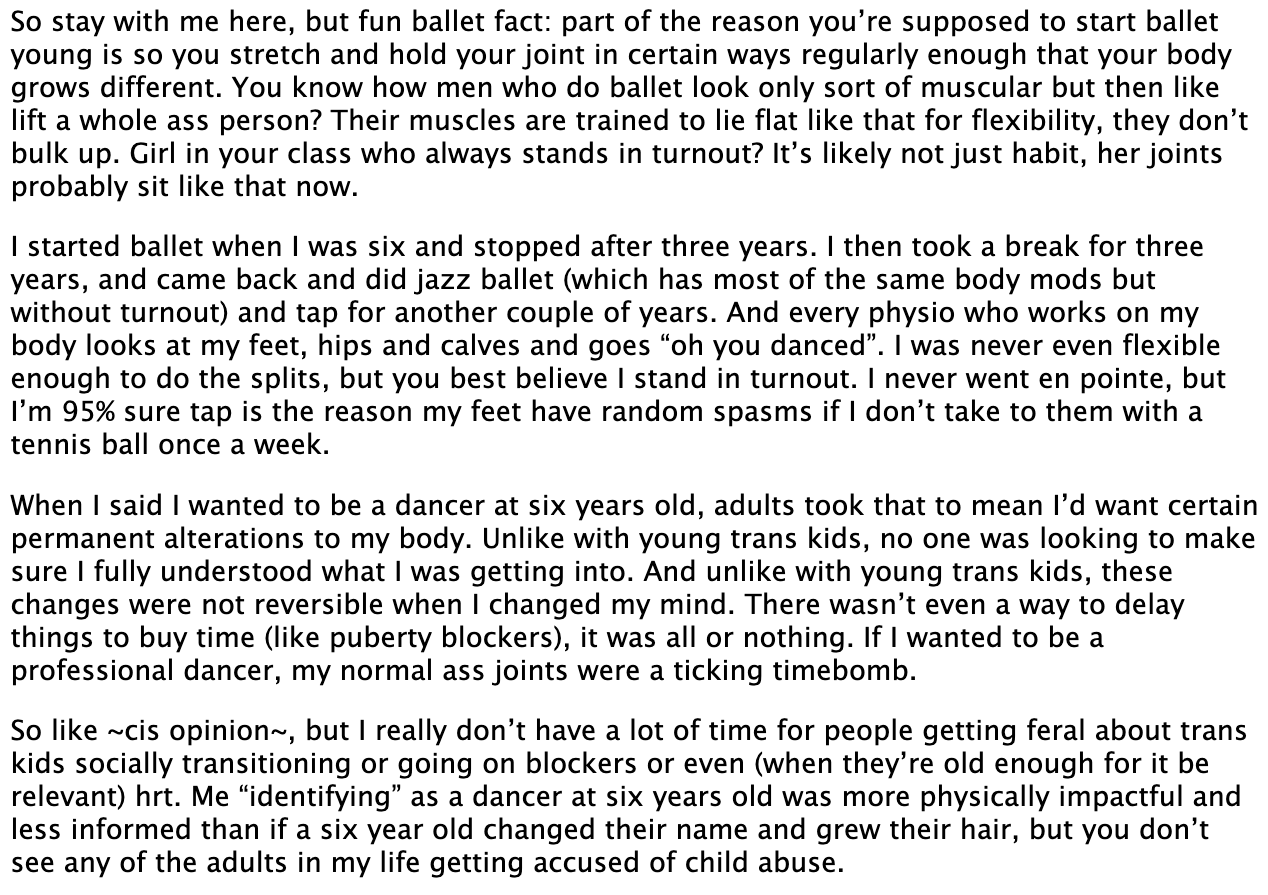
Tae Kwon Do did not alter my body as extremely as ballet and gymnastics permanently alter the bodies of many, many prepubescent children, but it was a set of changes that forever altered the course of my life, that I consented to without anything like full understanding of the ultimate result.
(To reiterate: I think you can’t ever actually have full understanding of the ultimate result; we simply do not know what will come of going where we haven’t gone before, even if we have fairly decent guesses based on our own experience (or the experience of others like us). I think the people who advocate for fully informed consent in approximately all things are deeply confused.)
Okay, but still, that’s not sex, Duncan, stop being disingenuous. When people talk about grooming they’re talking about child molesters.
I’m not trying to be disingenuous. I’m trying to point at the confusion. I’m on team protect-children-from-child-molesters. But some of the people on my team are wrong about which things are warning signs of what, and that means they’re going to do a worse job of actually protecting kids.
For instance: it’s good and healthy, actually, for kids to be able to wrestle with adults, and the process of going from [zero physical intimacy with a kid] to [wrestling with them] is indistinguishable, for the first dozen steps or so, from the process of a child molester wearing away a kid’s boundaries. The early stages look the same. Pathologizing the whole process is a mistake, and one whose costs are largely borne by children.
(We are in the middle of a loneliness epidemic, and touch starvation downstream of pedophile panic is a huge part of that.)
What makes something grooming, in the pejorative sense, seems to me to be something like:
The person doing the grooming has a target, and they don’t much care whether that target is good for the person being groomed or not. e.g. a child molester is attempting to groom their victim to the point of acquiescing to sexual assault, without complaint, and the child molester doesn’t care about the costs this will impose upon the child. The person doing the grooming isn’t searching the territory, for things which are presently red or yellow but might (within the victim’s CEV) genuinely deserve to be green, but rather has selected a section of the territory (that’s presently red or yellow) and is aiming to make it green, by force.
But this worries me. It worries me in part because if what lets us distinguish grooming from normal, healthy, gradual accumulation of intimacy is mind reading, i.e. deciding that we can reliably infer people’s ultimate intent, then we’re fucked. It worries me because even people who have solidly benevolent intent do massive amounts of harm, all the time.
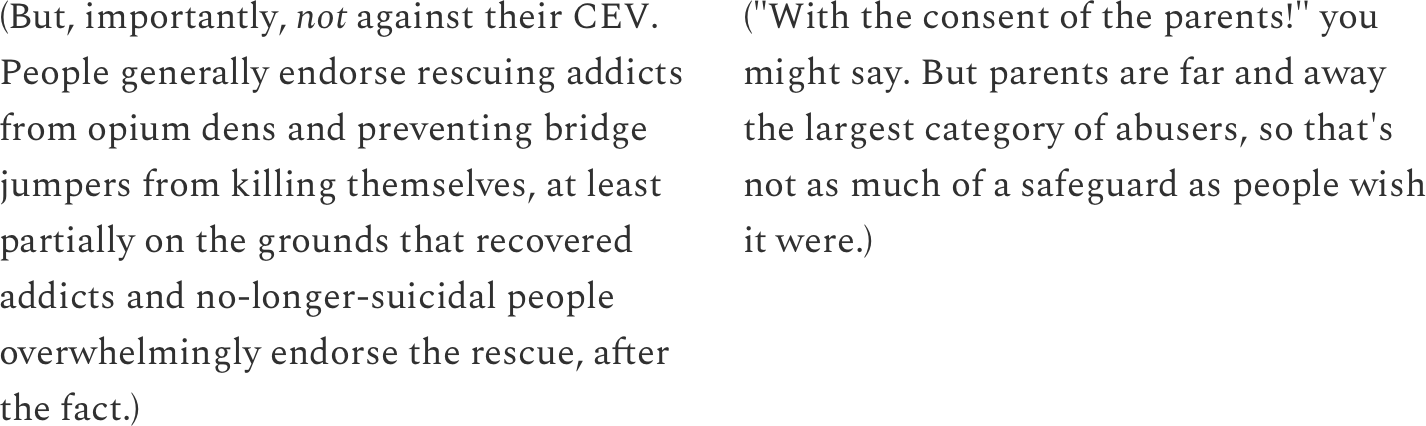
And it worries me because the above sounds a whole lot like teaching, or parenting (or at least, like the way a lot of teachers and parents teach and parent). “I know better than you; I’m doing this for your own good” is an extremely common sentiment, and one that our society broadly endorses and condones, and it’s often actually correct.
(It’s even sometimes correct in the domain of physical intimacy, I think! Our current touch-starvation seems downstream of the evaporation of all kinds of casual physical intimacy, and in my experience, people who are half-traumatized by a lack of touch often tend to avoid touch, in a kind of self-reinforcing doom spiral, such that it might actually be good to intentionally habituate them to touch, possibly even “against their will” in the sense that, y’know, someone who is erroneously and self-injuriously self-isolating doesn’t want that. It’s red for them, in their current state.)
All of these thoughts make me uncomfortable. They make me want to freeze in place until I can figure some more shit out.
(And meanwhile, less cautious and less moral people are charging ahead.)
VIII.
Here’s the thing.
I think we really, actually, truly just … cannot tell, reliably, what’s going to be good for other people (including but not limited to children).
The kids who were forced to practice piano for hours every day seem to me to be pretty evenly split into adults who are grateful that their parents arranged for them to have such a lovely skill, and adults who are seething with resentment about all the wasted time, all the lost afternoons and weekends that they’ll never ever ever get back.
And the kids who were not forced to practice piano also grow up into adults who are either a) grateful that their parents didn’t do anything stupid and coercive, or b) resentful that they missed all of their chances to start early and develop truly deep skill (like their elite overachieving peers, who make them feel inadequate all the time).
I’m not trying to do a fallacy of the grey, here. There are some distinctions that are obvious. It’s just actually bad to hit kids. That one’s clear. There are no studies that show that hitting kids is good for them, and plenty that show that it’s bad.
It’s just actually bad to rape people. That one is also clear, and it’s especially bad to rape kids. I’m not saying we don’t know anything about trauma, and what induces it.
But I don’t think we know enough to confidently claim we can avoid it. Knowing a handful of things that are definitely going to fuck a kid up is not the same as knowing how to dodge all of the things that are going to fuck a kid up, especially since the same action can have literally opposite effects on different kids.
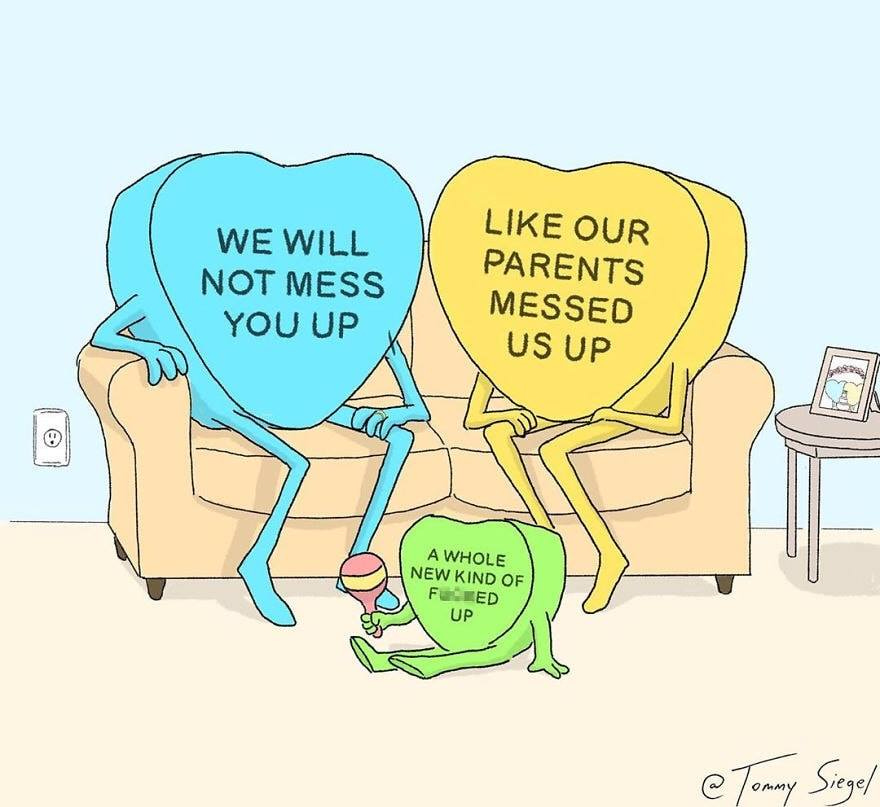
As a teacher, and as a parent…
I like to think that I can peer into the realm of all-the-things-the-people-under-my-care-currently-find-red, and identify, on their behalf, which ones “ought” to be green. Which parts of the territory they need help transitioning toward, but will eventually be glad they accessed (and grateful for the help I gave them, getting there). I like to think that I can tell that stuff apart from the stuff that they will always hate, or later regret.
But I do not, in fact, possess this skill. No one does. Anyone who claims to is lying (probably to themselves), and hand-waving away all of the inconvenient messiness of reality.
I think it’s worth pausing for at least thirty seconds to ponder this sad truth, before moving on to the next paragraph. To seriously roll it around, let it sink in. What if’s really, truly, actually the case that knowing what’s best for a given person is a fabricated option? What if you can never get the chance of inflicting unintended trauma down to zero, or even reasonably close?
I don’t think that the answer, in that world, is “never try to positively influence the lives of the people around you.” I don’t think the answer is “stop trying to nudge people in the directions you think are healthy.”
I also don’t think the answer is “fall back, in every case, to explicit verbal reasoning and explicit verbal consent.” I think that people in my corner of the world are way overdoing it with that particular tool, and are plugging their ears and going lalalalala to the ever-increasing piles of evidence that this is not a panacea.

(It also often seems to me to be a move based in something like … cowardice? Hand-washing? “I’m going to lead you into this new swath of territory, but only if we pre-establish that it’s all your fault, you were the one in control, you made all of the decisions.” It seems, in many cases, to be motivated at least in part by a kind of cover-your-ass spirit, rather than by an actual desire to center the other person’s autonomy and sovereignty.)
But a part of the answer does seem to me to be “smoothing out the transitions that you inflict on other people.” It seems straightforwardly true to me that there is a subset of trauma that is caused by abrupt transitions, and prevented by gradual, smooth ones.
And (currently) the word our society uses for gradual, smooth transitions imposed from without with less-than-perfect consent is grooming.
I wish we had separate words for the nefarious, selfish version and the benevolent, altruistic version. Even better, I wish we had words to separate intent from ultimate outcome.
But we don’t. Ours is a society that can’t tell those colors apart, and has just one word for all of them.
IX.
All things considered, if someone is going to rape me, I do, in fact, want them to spend ten minutes slowly loosening me up. If I have the option, I absolutely smash that button.
Do not mistake my meaning. I would rather not be raped. And being loosened up doesn’t make the rape any less rape.
But still. One of these things seems clearly less damaging than the other. The Pemalites aren’t wrong to prefer smooth transitions.
In fact, if I have the option to smash a button where they slowly seduce me over a period of months, and gradually exposure-therapy me into wanting them to rape me, I choose that, too. If I truly have no control over the ultimate outcome, and only over the path we take toward it…
Again, let me be clear. I do not want my sovereignty violated. I do not want to be brainwashed. Doing this to me would be bad. It’s just that it seems to me to be genuinely less bad than the alternative.
By the way, I am keenly aware that I am a weird person. I don’t believe that, just because I would push those buttons, everyone else would, too. Maybe you disagree! Shout at me, in the comments!
But it really does seem to me that, in a world where your options are “inflict experiences that will have uncertain effects upon other people abruptly,” or “inflict those experiences on other people, but gradually, giving them time to acclimate,” the gradual option is in general the kinder and more moral way to go. It’s less likely to be traumatic. It gives the other person more time to adjust their narrative to accommodate the new experiences you’re throwing at them, more time to let the yellow ripen into green.
(It also gives them more chances to hit the eject button, and actually tell you to stop. Like, sure, slowly habituating people does increase the risk of frogboiling, maybe they would have rejected X if you presented the ultimate end state to them in advance, but surely a gradual progression toward X is still usually better than WHAM guess what, it’s already happening to you, nothing you can do about it now…?)
(Oh, right: probably another piece of the puzzle is that nefarious grooming tends to obscure the final target, whereas more wholesome versions tend to be open about the endgame (“this process will gradually cure your fear of spiders”). But this still isn’t a pure discriminator—there are good outcomes that are ruled out by being named too soon; think “person who realized they wanted to marry the other person after just two dates, but played it cool long enough for that to not seem creepy or weird before confessing,” or certain educational outcomes that require that the students spend some time confused and frustrated in order to grok the lesson. Maybe we should make a dark sacrifice of all transitional processes that don’t put the thesis up front, but I think if so, we should do that with our eyes open, and acknowledge the extremely real costs!)
X. An unfortunately abrupt conclusion
(but this section title helps smooth it)
Ultimately, this is not a settled question, even in my own head. I don’t think I have concrete takeaways. The purpose of this essay was to unsettle you, because I’m pretty sure that most people are too certain and too complacent in this domain—too sure that they already possess adequate understanding—and that the world would be a lot better off if more people noticed all of the detail they’re glossing over.
That being said, I do think there are a few things that are pretty straightforward, and underdiscussed/underendorsed in our current culture:
What is “green” is not always good; people can be moved to a state of greenness that is not in line with their CEV. (This is the main mark against gradual habituation: the victim’s acceptance doesn’t mean they’re actually in a good place.)
What is “red” is not always bad; many experiences that would harm you now are genuinely beneficial to some future-you. (This is the main argument for gradual habituation, and it’s taken for granted in the realms of parenting and teaching.)
Thus, the process of gradually habituating people, such that they gain green-or-yellow access to territory that was previously red, is not obviously good or bad—but it is almost always less jarring, and that’s an axis of harm reduction all on its own.
Notice, then, that a substantial chunk of what people malign as “grooming” is therefore actually good practice (when it’s not adversarially geared at getting a pliable victim to let you molest them without complaint). Notice that just because something happens to look like your mental picture of grooming, that doesn’t necessarily mean it’s actually The Bad Thing. Notice that you need something else if you genuinely care about telling the good version and the bad version apart.
Beyond that, I don’t know. Try not to hurt anybody in ways they don’t want to be hurt. As much as you can, let people know where you’re aimed at taking them before you try to take them there. Overall, have humility: you (probably) know far less about the future than you think you do, especially when it comes to other people. Sorry, I’ll be less sick (and correspondingly more coherent) next time.
This seems tangentially related, and I think it's less of a problem now than is it was 5 years ago (or maybe I've just sufficiently changed my community affiliations), but I'm going to bring it up anyways.
One thing that frustrates me is the expansion of the term "gaslighting" to encompass any instance of someone disagreeing with your interpretation of events. But, like, it's not gaslighting if I honestly think you left the gaslight on. "Gaslighting," as it's meant, requires nefarious intention.
If Alice tells Bob "I can fly," Bob isn't gaslighting Alice if he says "no you can't," even if Alice ends up having some magical flying ability. Bob has every reason to think Alice is mistaken and that her mistaken belief will cause her serious harm.
But, like with "grooming," distinguishing between the nefarious and benign versions of "gaslighting" requires mind-reading, which caused people to default to "all denial of personal interpretation is equivalent to the maximally evil version."
For me, and I suspect many others, there's an element of Control Of One's Own Life that matters separate from goodness or badness of experiences. It's especially important to explicit verbal consent, but applies throughout.
If I tell my GF "let's try pegging", or she says that and I say "ok", and it turns out to be a really painful and horrible time, then I made a mistake, suffered and learned from it. And I can move on.
If she were to try it without check in, even if she were objectively as skilled as I in predicting my reactions to experiences, that would be hard to recover from.
I realize this gets more complicated when children are involved.