

This essay is a bit rough around the edges; it’s been in the pile of Essays I’m Vaguely Working On for over a year and I decided to push to get it out the door this week, because [gestures at everything].
Part of why I feel okay about sending it out unsanded is that the thesis is not a complicated one:
Our concept of “we” is confused and broken, and the way that we draw the boundaries of us is causing massive amounts of suffering, confusion, and death.
When I was younger, if someone said something like “we should go to the movies” or “we’re doing such a bad job at this” or “but we hate lasagna,” my father would often snap back with the same standard catch phrase:
“What’s this ‘we’—you got a mouse in your pocket?”
I probably heard this line upwards of five hundred times, during the five-thousand-or-so days of my childhood. I think I did not appreciate, at the time, how valuable and important this reflexive anti-validation of the default, knee-jerk “we” would turn out to be. Today, I’m deeply grateful for the grooves that my dad’s tired, offhanded joke wore into my mind.
Playing fast and loose:
I think there’s a natural human tendency to do something like:
a) assume kinship and solidarity, in a sort of typical-minding, of-course-the-people-around-me-agree-with-me-about-obvious-things way, and
b) take actions to build and reinforce this kinship and solidarity, emphasizing and strengthening the bonds of similarity with nearby people.
This process can flip, suddenly, when people hit a threshold of “oh, wait, never mind, this person in front of me is one of Them.” But most of the time, the default motion is an expansive, inclusive we-spirit unless and until something pops up to interfere with it. Humans are natural coalition-builders, and they’ll bond over just about anything.
(You know, like how we all love Bob Ross and Steve Irwin!)
(Wait a sec, are you saying you don’t love Bob Ross and Steve Irwin!?)
This … psychological module? … developed in an evolutionary environment where a given human would see a few hundred other humans on the regular and maybe a thousand or so humans ever, in their whole lifetime.
Now, we live in a world where millions of other humans feel relevant to us in one way or another, and our we-machinery is … let’s say no longer calibrated.
Recently, I saw a Facebook post which (let’s be honest) may in fact have been written by a paid Russian troll or an artificial intelligence. But it was plausibly the earnestly-held opinion of a real human; I have seen such opinions expressed by real humans before.
In the post, the writer was referring to the atrocious mistreatment of a child in the current Israeli-Palestinian conflict, resulting in that child’s horrific and agonizing death.
In response to that atrocity, the writer said, in essence, “okay, that’s it. The perpetrators of this horror are now beyond hope and beyond salvation. It’s scorched earth time. They are all monsters. They need to be exterminated, all of them—down to every last man, woman, and child.”
(I’m not exaggerating the strength of what they said. I’m not connecting dots, or leaping to conclusions. These were basically the words on the page, and again—very easily could have been fake, but also very depressingly recognizable as the sorts of things I see real actual people say, all the time.)
I’m obscuring whether the child was a Palestinian killed by Israelis or an Israeli killed by Palestinians because it does not matter for this particular point I am trying to make. A child was tortured and murdered. As a result, a person thousands of miles away felt directly, personally attacked, and responded to those feelings of being directly, personally attacked with an explicit call for the extermination of thousands of other, unrelated children.
I think some people might (reasonably) squint at the word “unrelated” above, and that’s sort of the crux of the issue.
On September 11, 2001, nineteen hijackers flew planes into the World Trade Center and the Pentagon, killing thousands. Most of those thousands could not reasonably be said to have anything to do with the conflicts and oppression in the Middle East that led to the hijackers’ actions.
Shortly thereafter, American soldiers invaded Iraq, again killing thousands. Most of those thousands could not reasonably be said to have anything to do with the 9/11 hijackers.
On October 7th, Hamas terrorists launched a multi-pronged attack on Israel, killing roughly 1,200 people, injuring roughly 5,500 more, and kidnapping 251 hostages.
The Israel-Palestine conflict is smaller and more intimate than the America-Islamosphere conflict; it’s plausible that some of the people killed or injured in the Hamas attack had actually done overtly immoral things toward Palestinians.
But that’s not why they were targeted. It wasn’t direct retribution for direct, harmful actions. The “we” of Hamas attacked the “they” of Israel, with no care or concern for the details.
Subsequently, the “we” of Israel retaliated against the “they” of Palestine, killing some sixty-five thousand Gazans.
People talk a lot about the dehumanization of “they,” the way that humans have a scary property of being able to turn cold and callous toward vast swaths of “others.”
But I think there’s a failure to talk about the whole other half of the problem, which is the “we” part.
Nobody attacked me on September 11, 2001! I was hundreds of miles away, at a semi-rural high school in Alamance County, North Carolina.
There’s a thing that happens to a lot of humans, when they are driving their cars, which is that their sense of self expands to fill the space taken up by the car. Trespasses upon the car trigger the same emotional (and in some cases, physiological!) reactions as trespasses upon one’s own body.
This is a little bit explained by and validated by the fact that what happens to your car can in fact pretty significantly impact what happens to your body; it’s not ridiculous to protect your car because you want to protect your body.
But I think that if people be real for a minute, they will acknowledge that it’s pretty clear that that’s not all that’s going on. People will (for instance) become so affronted at a very minor violation of their car’s personal space that they will go on to engage in extremely risky and dangerous road rage behaviors like flooring it and swerving in and out of traffic and slamming on brakes and so forth. Something more than just not-wanting-their-body-hurt is happening, or they would behave differently in such moments.
They’re letting their sense of self bleed into a place where it shouldn’t be, with serious downsides as a result. Things which happen to (or even just vaguely threaten) my car are distinct from things which happen to (or vaguely threaten) my actual person. There’s an overlap, yes—and if you lose track of the parts that don’t overlap, you can go crazy.
I’m not saying I shouldn’t care about the September 11th attacks. They were relevant to me. They matter. The direct deaths matter, and a coordinated group of hostile humans considering me part of their target matters. I do, in fact, feel concern when Americans are attacked because they are Americans, because I am an American, too.
(There’s a way in which Tucker Carlson justified his cozying up to the Russians by saying, essentially, “Russians haven’t ever been mean to me; liberals have.” I’m cognizant of what’s wrong with this statement, and I’m not trying to say an analogous thing. I think that the thing I’m trying to point at, with this essay, is a big part of the explanation of why Carlson’s statement was confused and bad.)
The fact that the 9/11 terrorists conceived of me as indistinguishable from the people in the World Trade Center, and indistinguishable from the other 285,000,000 people in America at the time of the attack, doesn’t mean that I’m actually indistinguishable.
It’s tempting, when someone points a gun and says “you’re all the same; your differences do not matter to me” to, y’know, feel a lot of solidarity with the other people being threatened. It makes a lot of sense, actually, to ally with those similarly threatened, find common cause in defense.
But—
But—
But we’re still different people?
“Allies” are ALWAYS people with whom you have major disagreements and points of divergence. If you didn't have disagreements and points of divergence, you wouldn't be “allies,” you’d just be literally the same team.
Allyship is about having a shared cause that is currently more important than those disagreements. It's not about those disagreements not existing.
Coming at it from the other direction: I don’t think it makes sense to feel much more sadness and despair and grim determination over the deaths of 3000 Americans—
(who are elsewise unrelated to me in any meaningful way)
—than I feel over the deaths of 3000 Canadians, or 3000 Germans, or 3000 Kenyans or Kuwaitis or Kazakhs or Koreans.
A little bit, sure. The Americans are … closer to being potential friends and family members? They have a smaller Bacon number? They are in fact likely to share more of the values that I think are important, than someone from a vastly different culture? They’re relatively more likely to come to my defense, if I’m attacked, and that does actually matter, and I should hold up my end of the bargain?
But it doesn’t matter to the point that I would rather e.g. six thousand foreigners die, than three thousand Americans. Given that I am an American myself, I maybe endorse valuing other Americans higher than I value humans-in-general (maybe) (I’m really not sure on this point), but I absolutely don’t think an American should count for twice as much as another human—
—let alone over a thousand times as much.
Almost a million people were killed in direct war-related violence after 9/11; another estimated four million died for more indirect war-related reasons. Most of those deaths were not American deaths. More than a thousand of “them” for every one of “us” that died on 9/11.
(Compare also the 65,000 Gazan deaths in the past two years to the estimates of 5,000-15,000 Israelis killed by Palestinians over the past seventy-seven.)
Yes, a major part of this problem is the othering—the fact that “we” didn’t consider “them” to have sufficient moral relevance to soften our retribution. That we underweighted the magnitude of meaning in their deaths.
But another major part of it is conceiving of it as retribution at all. Viewing the killing of [unrelated strangers 3], because [unrelated strangers 1] killed [unrelated strangers 2], as a valid and justifiable tit-for-tat.
Thousands upon thousands of Americans signed up for the war effort, feeling themselves to have been directly attacked when 19 foreigners—
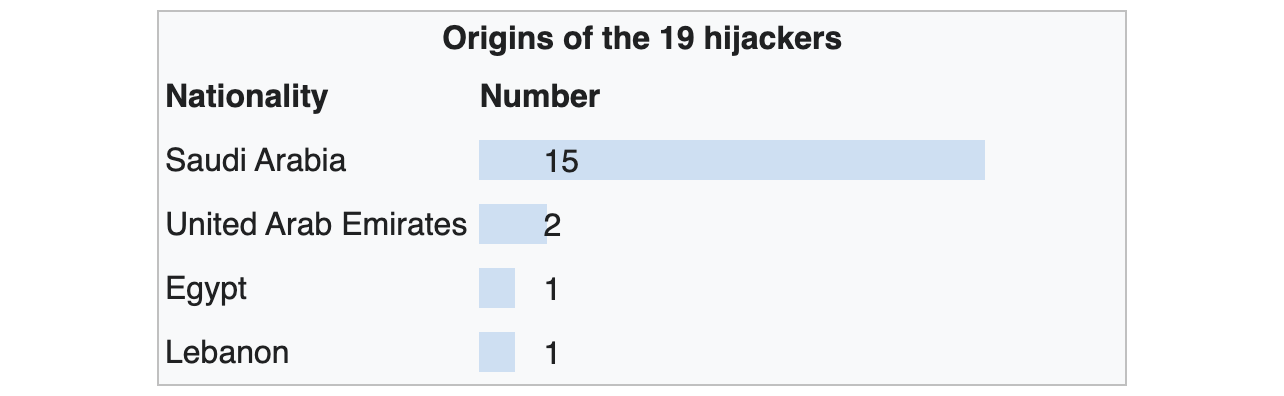
—killed 3,000 people in New York and Washington (and on Flight 93), and then those soldiers laid the responsibility for those deaths at the feet of (basically) random strangers in Iraq and Afghanistan.
And then killed them about it.
We can talk about escalation, and we can talk about empathy, but one thing we don’t talk enough about is “we,” and how our absolutely haywire mythology about which people belong in which buckets is upstream of thousands upon thousands of murders.
There’s a line that I find myself quoting rather frequently, from a fanfic I’ve read many times. It’s not a perfect match for this topic, but it does happen to be from a moment when someone is being wrongfully held to account for something they didn’t do:
“This folly does not become you, Lucius,” said the boy. “Twelve-year-old girls do not go around committing murders. You are a Slytherin and an intelligent one. You know this is a plot. Hermione Granger was placed on this gameboard by force, by whatever hand lies behind that plot. You were surely intended to act just as you are acting now—except that Draco Malfoy was meant to be dead, and you were meant to be beyond all reason. But he is alive and you are sane. Why are you cooperating with your intended role, in a plot meant to take the life of your son?”
Am I culpable, in the deaths of five million people in the two-and-a-half decades since the 9/11 attack?
Did I kill those Iraqis? Did I kill those Afghans?
It sure doesn’t feel like it. But I am an American. My labor turns into economic value which turns into taxes and some of those taxes go to the American war machine, which does what it wants regardless of my feelings about it. If an Afghan orphan is angry with me, because their parents were killed by Americans, I don’t quite feel like I have zero responsibility. I don’t want to confuse “I didn’t choose this and do not want this and took no direct action” with “therefore I’m innocent”—someone who works cleaning the toilets at a concentration camp is helping to maintain a machine of death.
But I also don’t feel the same way I would feel, if my brother killed the orphan’s brother, and the orphan felt like killing me in response. Something about that is more …straightforwardly understandable. Cleaner, clearer, saner. I still don’t feel responsible and I still don’t want to die (am I my brother’s keeper?), but I get it. Becoming the specific target of their wrath in that scenario feels more reasonable.
Did I benefit from slavery? Does it make sense to talk about what “we” did to black people, hundreds of years before I was born?
I think so. Sort of. I think it’s pretty reasonable to point at how my family is doing better than many black families in the same town, and hazard that the obvious assumption is probably true. You can’t prove that a given hurricane was caused by climate change, or that a given race was won because of doping, but also “c’mon, be real.”
Did I … do slavery? Should I in fact say that “we” enslaved people, and that was bad?
Should I say that “we” ended slavery, and that this is to “our” credit?
Did I win the Superbowl? Did I even participate?
Did I win the election? Did you? Did any of us?
Am I a rationalist?
They say “we” are experiencing health problems downstream of microplastics being everywhere in our environment. That feels valid! I think I’m a member of that “we”! Properly so!
Am I part of the “we” that did the pollution?
There are a lot of men out there doing pretty awful things to women. I’m not one of them. I’m not friends with any of them—at least not knowingly (and I do in fact make a genuine effort to check, rather than just turning a blind eye).
Am I part of the “we” that is doing awful things to women?
I don’t think so. I feel perfectly comfortable when a woman who does not know me treats me as if I am a dangerous man, because that seems reasonable and sane and wise; she does not have any particular reason to trust me and she does have reason to be wary, so I don’t take it personally and I don’t dock her any points for keeping her shields up.
But I don’t feel any guilt or shame or culpability when some man who isn’t me and isn’t my friend and isn’t my responsibility in any way does a horrible thing that I had no realistic way of knowing about and no opportunity to prevent.
So … to that woman, I’m part of the “we,” or at least not obviously not part of it. And I accept being treated as part of it, by default. And I also don’t feel part of it, at all.
Is my family a “we”? It certainly doesn’t feel like it. On my dad’s side alone there are five aunts and uncles and something like seventeen cousins with basically zero agreement on anything. Even in my immediate family, it’s not like there’s any sort of unity of purpose or meaningful, coordinated action.
This feeling that I’m feeling right now—that I’m hopefully succeeding at inducing in you—this is what it feels like to notice a broken category. To do the movement recommended in Logan Strohl’s naturalism, or in other essays of mine such as White Chocolate Is Not Chocolate. The “we” concept didn’t come out of nowhere. It’s not nonsense. We use it because it makes (some) sense, and does (some) good work.
But it’s not real, and our confusion about that leads us into some very dark places.
(“What’s this ‘us,’ Duncan—you got a mouse in your pocket?”)
There’s a standard piece of advice that goes “keep your identity small.” When people offer this advice, they’re usually focusing on you—the internal you, the stories you tell about yourself. Don’t adopt an identity of “not a fancy person” that prevents you from enjoying fine things, for instance.
But the flip side of it matters, too. I don’t think you should identify as (for example) a Republican, such that, if someone does something awful to a Republican, you feel attacked.
(Or such that if a Republican does something awful, you feel like you have to defend it, have to come up with rationalizations and justifications for it as if defending yourself.)
There are some 150 million Republicans out there. There are very few meaningful senses in which they form a “we” that should cause a person to feel … involved.
In the imaginary language of the imaginary land of Agor, there is a very short word:

It’s pronounced “Ē,” exactly like “we” except without the w at the front.
What Ē means is no, not we. It’s my dad, asking about the mouse. It’s a “really, though?” when a fan says “we won!” about their favorite sports team.
(This is a slight buzzkill! I know! But Agori culture holds that the slight buzzkill is a lesser cost than going off the deep end and losing track of where I end and we begin.)
In Agor, we (yes, we) teach children to respond with Ē. We model the behavior of noticing the claim, and responding with gentle skepticism. We explicitly remind them to practice using the word—it’s like reminding children to say “please” and “thank you” at the appropriate moments.
We do this because we know that really dark and scary things happen, actually, when people lose themselves in the we, imagine deeper connections than they actually have, extend their noses so far that a total stranger being hit causes them to feel ow.
It’s extremely valid to care about total strangers being hit. It’s extremely valid to treat that as morally and strategically relevant, and to take action in response. There’s something at stake for me if a stranger is being assaulted in a parking lot, because I want to live in a society where people are safe, so that I can feel safe.
But all of that is different from the emotional feeling of being attacked, myself, and my fellow Agori remind me of this with the short, simple, gentle utterance of the word Ē, and that’s why Agor has fewer instances of Grangerfords and Shepherdsons than America.
(You can have empathy for the victim of an assault without feeling that your own self was actually threatened or violated.)
You can say no to Ē. It’s not a flat assertion. It’s not an argument-stopper. Sometimes the “we” really is valid, and the answer to “really, though?” is “yes, actually.”
(Sometimes you actually are on the team, and actually took part in the endeavor.)
But it’s a reminder. It’s an attention-summoner. Ē is a pressure against the unhealthy natural default—of letting your identity swell until it encompasses total strangers, of letting your mind lump others together just because they share a single trait, or live in vague proximity to one another, or have one or two beliefs in common.
I think that a lot of people don’t notice that there’s a throughline between “wahoo, we won the Superbowl!” and stuff like racism and sexism.
But as far as I can tell, they’re made of the same fundamental particle. The idea that you know something about this person, because you had an interaction with that person—the idea that he is a valid target for the grievance you have with that other guy, who isn’t even here—
I think that sort of thing starts inside our own heads. I think it comes from confusion around which “we”s we are a part of, and letting ourselves fall into the habit of believing in intangible, imaginary, illusory bonds of connection and belonging.
(The claim isn’t that bonds of connection and belonging don’t exist and aren’t real. It’s that some of them are hallucinations and gross exaggerations.)
There are people who considered killing Iraqi citizens in response to 9/11 and felt bewilderment, because what? No, seriously, wait, what?
…and there are other people whose response was yep, sounds about right.
I think that there are really quite a lot of things that make those two kinds of people different, but I think that people who also feel a bit squeamish or weird about sentiments like “we won the Superbowl!” are at much, much lower risk of ending up in the second category.
Ē, by itself, is not a solution. What I’m offering here is not even a complete and mature understanding of the problem.
But Ē is a useful tool. It’s a patch, and using the patch—building the habit of using it—can help a lot with staying in touch with that problem. With not forgetting about it, and sliding back into bad habits. The very existence of the word Ē is a little reminder to the citizens of Agor that oh, right, there’s something weird about the way my brain interacts with this whole “we” thing, by default; I don’t understand it fully, I’m going to keep getting it wrong, some of my attempts to improve the situation might actually make it worse, but right, don’t forget, there is in fact a problem here.
Enough of one that, in Agor, we go around reminding each other about it, just like we might gently correct misgendering or say “maybe you’re too drunk to drive.”
I'm very fascinated by us vs them, in group vs out group problems, and this feels like an important part of it that I hadn't thought about before.