
Can't, Gotta
(shortpost)

ok (at least) one more shortpost before I get back to trying to get my larger points in order. this one is ranty
I wish more people thought about both sides of autonomy and sovereignty violations.
Our society spends a lot of time on avoiding “gotta,” by which I mean “you’re forced into a thing against your consent.” Child labor laws are anti-gotta. Rape prevention and sexual harassment prevention are anti-gotta. Minimum wage is not an especially effective intervention, but it is aimed at preventing people from “having to” work extremely shitty jobs for insufficient pay, and it achieves this at least a little.
Anti-gotta is great. I have no objection to it, in principle. The more that you have to do stuff, despite not wanting to and despite it being ego-dystonic, the worse and more stressful and not-worth-living your life becomes. A+, a mature society works very hard to reduce the gottas; gottas suck and their costs are large.
But this society—by which I mean America in the 2020’s—seems to me to massively underweight the cost of can’t.
For instance: there are thousands-if-not-more thirteen-year-olds who are desperately bored and suffocating in school, and would kill to have an opportunity to just go out into the world and cut their teeth.
(Which was something thirteen-year-olds were never barred from doing basically forever, in basically every society, up to and including this one as recently as five generations ago.)
But our society is so scared that thirteen-year-olds will be gotta’d into work that it’s decided to tell the ones for whom that would be good “nope, sry, you just can’t. We’re incapable of distinguishing healthy thirteen-year-old entrepreneurial spirit from unhealthy thirteen-year-old coercion and exploitation, so we’re putting a lid on the whole thing.”
The part that bothers me is that the “can’t” is often handwaved away as though it’s literally zero. “They can just wait five more years, what’s the big deal?” says an adult who would absolutely not tolerate having their sovereignty locked down for five years, are you fucking kidding me?
(Let alone the fact that for a thirteen-year-old, five years is a lot longer to wait than for a thirty-year-old.)
(“But I had to wait, and it was fine!” screams a person who isn’t prepared to face up to the fact that they themselves were screwed out of something, better to perpetuate the system forever because then you don’t have to watch others get a better deal than you yourself got,)
I pretty much buy “okay, we just don’t have the social technology to reliably tell apart the kids who would hugely benefit from being free to enter the world of Real Actual Work from the ones who would be coerced and exploited.” I don’t like it, but I can buy that it’s theoretically the right call, at the societal level.
What I don’t like, though, is:
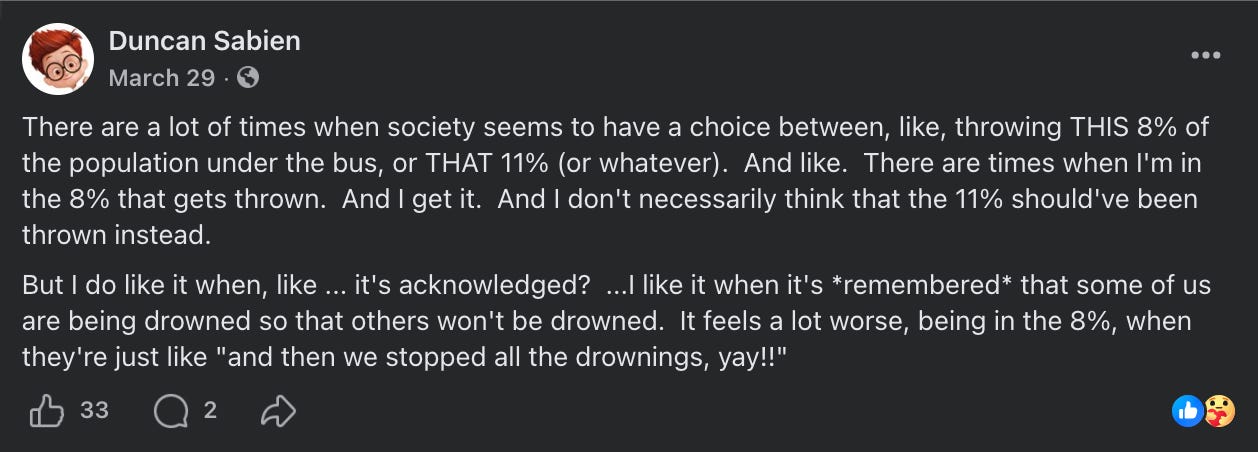
Not acknowledging that you are, in fact, coercing and exploiting some people, at a low level, so as to prevent a probably-worse coercion and exploitation at a more acutely disastrous level
(“Wait, what do you mean, exploiting? Nobody’s exploiting eighth graders by preventing them from working!” Oh honey. O you sweet summer child. Taking a human being and treating them as your property and pet is exploitation.)Not actually letting the equation be an equation. Making one of the terms infinite, such that it justifies infinite excess in the preventive direction. What people support, in practice, but rarely say out loud, is something like “I’d rather lock down a million teenagers and deny them their agency entirely than risk even one teenager ending up in the salt mines.”
(Except that actually, teenagers are ending up in the salt mines anyway; another part of why I rage at this whole dynamic is that it doesn’t even tend to protect all that many teenagers. It’s more “I’d rather lock down a million teenagers and deny them their agency than have to see and know about one in the salt mines,” which, man, fuck you.)
We prevent a lot of disabled people from ever having sex, on the grounds that they’re not able to protect themselves the way a non-disabled adult theoretically can; that it would be so bad for them to accidentally gotta that they are in the can’t bucket forever. This is deeply fucked up. It is deeply fucked up to deny a human being access to sex, forever, in the name of their own good, contra their own expressed preferences.
(The gotta’s that we’re trying to prevent are often acute, e.g. a sexual assault; the can’t’s that we impose upon people, prophylactically, are often an endless series of tiny cuts, the same “no” over and over and over and over and over and over and over.)
We deny people access to all sorts of pharmacological substances, ranging from the recreational to the medically necessary, on the grounds that oh no, it would be bad enough if some people got addicted or took medical action that they regretted or accidentally hurt them that this is worth barring everyone from making free choices.
(And then we never ever bother to check whether the math actually works out And then we do check and the math clearly and unambiguously tells us that we’re doing it wrong and we ignore the math and keep doing the paternalistic fascist thing.)
We engage in all sorts of can’t’s, and some of those can’t’s are, in fact, reasonable, but we’re so unreasonable in general that you can’t actually tell, at a glance, whether a given can’t is justified or not, because [two essays explaining why].
And it’s, uh, bad.
The people who call themselves libertarians seem to me, as a class, to be spineless unprincipled self-centered hypocrites, but they’re not wrong about this one.
It’s bad. The fact that most people agree that it’s good doesn’t mean shit; slavery and the holocaust both had local consensus backing them.
When you’re considering throwing dust specks in the eyes of ten million people to prevent the torture and murder of one, check whether it’s actually just a dust speck, and whether you’ll actually prevent a murder, please. I’m down to suffer a dust speck now and then, to save a life—
(I’m down, for instance, with at least some of the restrictions we put on minors, in the name of preventing them from being sexually abused, though again I’ll point out that the interventions don’t seem to be working, actually; nothing that we’ve changed about how our society functions over the past thirty years has had a meaningful, unambiguous impact on the rates of child sexual assault; the last time it actually substantially fell was in the 1990’s when all crime fell.)
—but I’m actually not at all down to have one hand tied behind my back for five years when it doesn’t even save anyone.
(“We can’t track effectiveness of these interventions because that would demonstrate that these interventions are deeply ineffective and point in the direction of us giving up all this power we’ve accumulated over other people, and we don’t want to do that.”)

Fuck.
(deep breath)
To bring it back around to a digestible conclusion:
“Can’t” is just as valid, as a category-of-badness-worth-minimizing, as “gotta.” Track it. Notice it. Don’t handwave it away.
Thanks.
The point about teens working also applies more broadly to how Westerners think about "sweat shops" (in quotes to represent a wide range of theoretically exploitative labor practices in developing countries). If you talk to people in those countries, they will not ask to be saved from exploitation by banning companies from employing them, which would make them even poorer. The tradeoff is very obvious to them and nobody is getting tricked into anything. Coerced by circumstance, sure; to fix that, you need to provide an actual better alternative, not just "can't" the thing you don't want to think/know about.
In the specific case of mentally disabled people and sex: yes, it's certainly bad for the mentally disabled people, but given the relevant power imbalances, how can we actually tell the difference between freely given consent and exploitation via manipulation or coercion?
(Other categories of people legally unable to give consent because of power imbalances are prisoners that cannot legally consent to sex with a prison guard and soldiers who cannot legally consent to sex with superior officers.)