
Explicit Verbal Consent
...is not a panacea

0.
Absolutely nothing in this essay is contra consent. It is, however, contra the conflation of [explicit verbal consent] with [consent]. A lot of people, in my experience, act like the diagram looks like this:
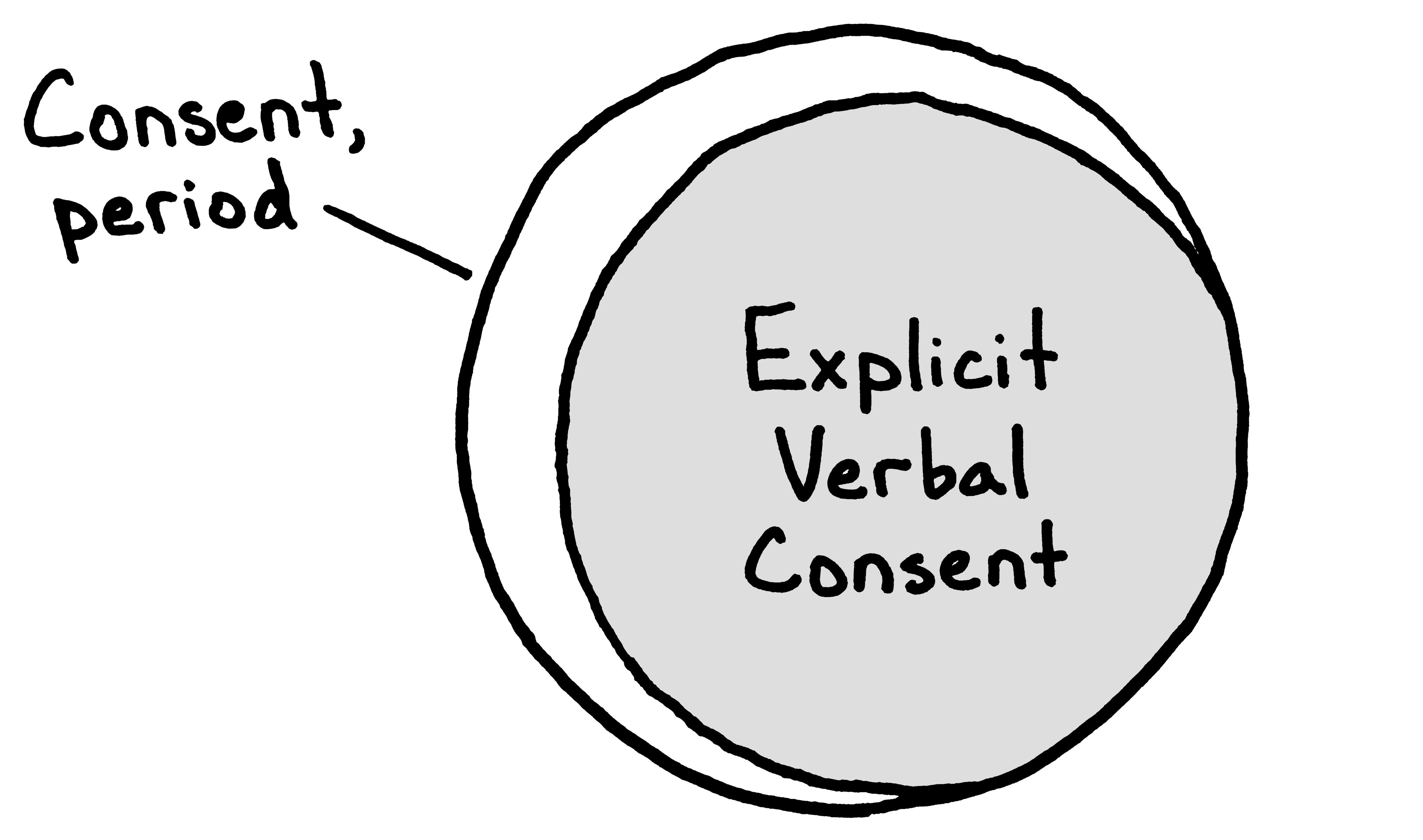
…when it seems pretty clear to me that it’s actually more like this:
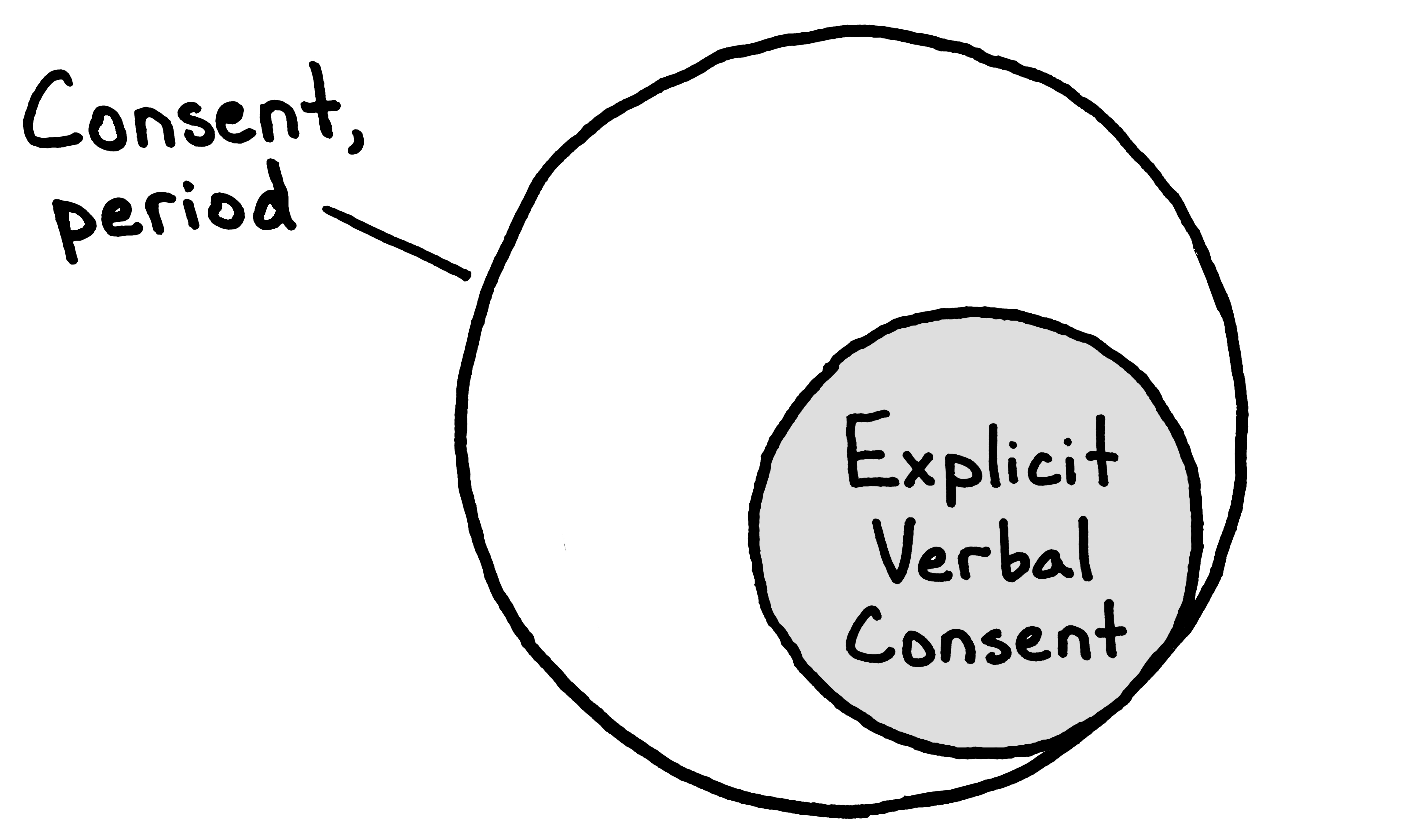
There are some situations where EVC is 100% the appropriate (or even necessary) tool.
There are some situations where EVC is one of multiple valid options.
And there are some situations where EVC is actively corrosive and bad.
It’s not a panacea.
I.
Defining terms:
By explicit verbal consent, I mostly mean the following two things:
Asking, in words, before escalating some sort of interaction (usually but not exclusively physical or sexual ones), and holding off on that escalation until receiving words that are or are equivalent to “yes.” (And on the flip side: insisting that “no” also be clear and verbal and explicit, too.)
“Negotiating” “scenes,” i.e. planning out encounters in detail, in advance, or at least setting clear themes and drawing a bunch of concrete boundaries (yes to X, Y, and Z; no to A, B, and C; M and N are on the table but may or may not happen).
I feel pretty pendulums about it.
“Feeling pendulums” means:
I agree that things were worse, before. The popularization of the social technology of explicit verbal consent, over the past few decades, has put an end to a lot of boundary violations, and has given a lot of people much better tools for expressing their needs and communicating with their partners. That’s great!
But I run into a lot of people who seem to think … “We did it!!” (or something). Who lean on explicit verbal consent for approximately everything, and act in ways that imply a belief that doing so has no costs and no downsides.
Maybe it doesn’t, for them! But other kinds of people exist.
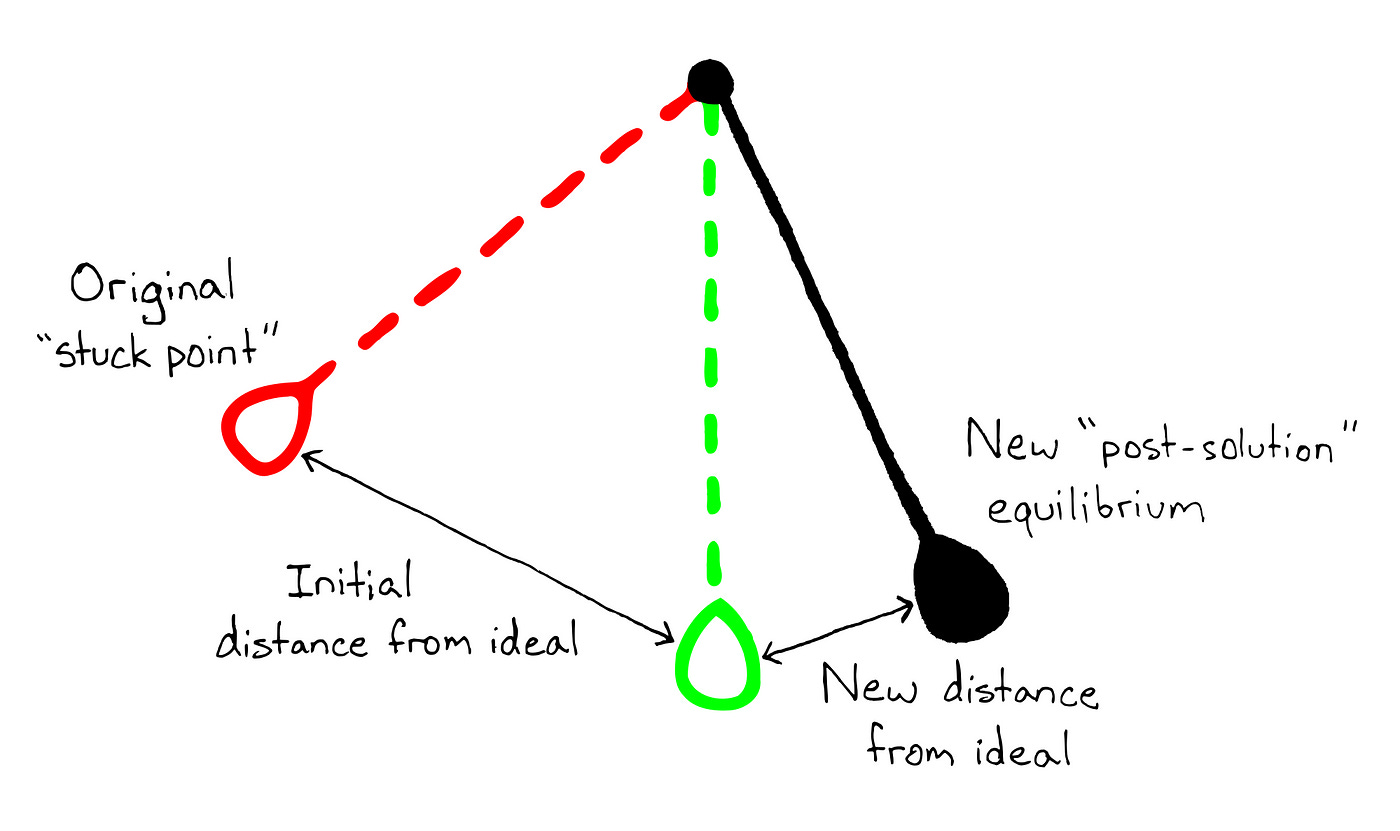
This brave new world is clearly less bad than the previous, but it’s not ideal. I’d like to talk a little bit about some of the things the verbal-type Pokémon are missing, and in some cases trampling over.
II.
First, though:
Guess culture is the term for an implicit mode of operation in which people are sensitive to the likely impacts of the things they say and do, and adjust what they’re doing, preemptively, taking those impacts into account.
If your parents ever scolded you for asking whether a friend could sleep over in front of that friend, that was a guess culture moment. Asking while the friend is looking on eagerly creates pressure on the parent to say “yes,” even if it’s not in fact a good idea or they don’t want to do it. The parent is sort of backed into a corner: they either grant permission, or they look like an ogre in front of your friend.
Guess culture says “you know that’s going to happen; the impact of putting your parent on the spot is predictable. Therefore a) don’t do it, and b) if you do do it, we’re going to act as though you basically created that pressure on purpose.” In guess culture, you don’t ask questions to resolve uncertainty—direct asks are reserved for when you’re already super confident that you know the answer.
Ask culture, in contrast, is explicit. Ask culture argues something like “look, I can’t actually predict how any given statement or action is going to impact you; I can maybe get kinda close but honestly different people are different, everyone has their own microculture and different people attach different connotations to things and people have wildly varying expectations and norms and I’m not a mind-reader, can I please just ask?”
Guess culture: don’t ask your friend whether you can crash on their couch for the weekend, because they might feel obligated to say yes; instead slap your thighs and say “well, it’s getting late; I’d better start figuring out hotels.” If they want you to sleep over, they’ll speak up.
Ask culture: “Yo, can I crash on your couch?”
Relevance to EVC:
Guess culture is largely for intra-cultural communication, i.e. communication between people who have a large shared base of norms and intuitions.
And ask culture is largely for inter-cultural communication, i.e. communication between people whose cultures are different enough that you can’t rely on both parties understanding the same “A implies B.”
EVC is an inter-cultural tool, just like ask culture. It is, fundamentally, based in the assumption that we can’t make assumptions. It’s a tool for people who are wary and cautious and uncertain, and using language to reduce uncertainty, and bridge cultural gaps.
From over here in my armchair, I see three big forces at work, in the rise of the popularity of EVC over the past few decades:
Internet culture causes people to collide with far more people who are far more different from them on a regular basis; no longer are you primarily interacting with people in a 20-mile radius of the place where you physically live. People have boned up on explicit culture in general because most of us are spending way more time in the company of strangers than in the past.
The destigmatization of therapy has caused lots more people to take advantage of it in the past 2-3 decades than in the 2-3 decades before that. And therapy is absolutely chock-full of explication. Millions of people have been practicing explaining themselves—to their therapists, to themselves, to their romantic partners—and the terminology and technology of making things explicit has leaked into the water supply in a big way.
In the realm of sex and intimacy specifically, kink/BDSM culture has spent the past few decades refining and exporting all sorts of technology for unlocking vulnerable, intimate interactions between total strangers. Thousands upon thousands of people have showed up at events where they knew next to nobody and been taught explicit frameworks for forming connections and making proposals and negotiating boundaries and moving (relatively speaking) very quickly to activities that would otherwise require a lot of built-up trust.
It’s that last one that I want to start with (although all three of the above share a similar underlying structure). I think that part of what’s going on with EVC is something like the metastasis of norms put in place to facilitate, er, “speed dating.” Kink event norms are like diplomatic norms—they’re a set of clunky, machine-like buttons that everyone knows how to press, so that people don’t accidentally try using their own cultural levers on one another.
You get people to agree, explicitly, on the meta level, to things like “no escalation without negotiation” and “consent can be withdrawn at any time” and “you and your partners owe one another specific experiences, in line with what was agreed-upon; neither of you has promised one another a good experience, because who knows how it will actually land?”
All of these agreements allow total strangers to become physically intimate at all without things going immediately sideways. This is great! It’s great to have tech for zeroing in on the details of a specific scene, and how it will start and end, and what things are on and off the table, so that there’s minimal misunderstanding and people’s actions are reasonably predictable.
But this is also different from something like—
(sorry)
(I know the way I’m phrasing this is value-laden)
(sorry)
(but seriously though)
—true intimacy. Actual attunement. Seeing and knowing one another, having that shared base of norms and assumptions.
At an event full of strangers, if your options are “welp, can’t understand these randos well enough to connect” or “oh, we can both push the big blunt buttons and get like an 80/20 of the real thing!” then obviously the latter option is way, way, way, way better!
But in other contexts, the big blunt buttons get in the way. They’re like—
(sorry, somewhat clumsy metaphor)
—they’re like a monoculture, a single species, like Bermuda lawn grass. They’re better than dirt, but they’re not as good as a thriving wildflower garden.
Processes which allow you to go from [zero intimacy] to [any intimacy at all] in the space of minutes or hours are often corrosive to the deeper, fuller sort of awareness and attunement, if it already exists. It’s good that you can ask a barista for the price of a coffee, and they’ll tell you, and then you can hand over some money and be given a receipt and receive your coffee, but it would be bad to deploy that technology with your friends, in your kitchen.
And through some weird slippage of monkey brains—
(Especially in subcultures that have A Lot Of People who’ve been through the BDSM training camps, or spent a bunch of time steeped in therapy culture, or just generally had to navigate a bunch of interactions with strangers on the internet.)
—the specific, heavy, overengineered technology of Big Events Full Of Wary People gets enshrined as The Right Way To Do Things, Period, and people start porting that tech into domains that are supposed to be running on a different language.
It’s, uh. Bad.
III.
Just a brief point: the dynamic of “X is worse than Y but it’s far better than nothing” is, I think, a part of why so many people have felt deep relief at being handed the tools of EVC. I feel like I see a lot of people who were lost in a fog of confusion and anxiety, and couldn’t get a grip on intimate interactions, and were stressed and afraid and under-nourished as a result…
…and then someone taught them the tools of ask culture/EVC and it was like opening a door and letting in light for the first time in years.
This is wonderful. Like, the point of this post is not to shit on EVC in general; as noted in the second diagram I think it’s a big chunk of the overall picture of consensual intimacy. And I know people who are like, “I am finally able to have conversations I could never have before, and those conversations are unlocking lovely experiences I could never have before, and being able to just ask my partners how they’re feeling and what they’re thinking and what they want (and communicate the same, about how I’m feeling and what I’m thinking and what I want) is a huge gamechanger. Before, I had so much uncertainty about what might happen to me, and whether my boundaries would be respected, that my only real option was abstinence. Now I can actually play.”
Valid. Valid valid valid.
And there are some people for whom the claims I made above (about verbal stuff being limiting or corrosive) aren’t personally true! There are some people who don’t take any damage, or experience any confinement, from passing everything through the verbal channel. And this is also rad and valid. I wouldn’t undo all of the cool invention and popularization that’s happened over the past few decades, because every new tool in the toolkit is useful to someone.
But—
IV.
Some things that the more zealous EVC evangelists seem not to notice, or to dismiss as irrelevant:
1. If you make participation in an activity conditional on verbal fluency, you are necessarily excluding from that activity everyone who isn’t verbally fluent.
This includes autistic people. This includes disabled people. This includes people who speak a different language. This includes people with certain kinds of social anxiety. This includes people of a lower IQ. This includes younger people. This includes people under the influence. This includes people who are scared or anxious or nervous.
I think it’s fine to set up environments where you say “sorry, you must be at least this verbally competent to ride.” The people putting on an event matter, too; doms and tops and dance leads matter; if the driver of an experience is only comfortable if they can get a certain level of explicit verbal clarity from the other party, that’s valid.
But it is in fact emphatically not the case that things like dance or sex or BDSM are (or should be) fundamentally gated on verbal fluency. They aren’t primarily verbal activities! It’s not like saying “sorry, you have to be articulate to participate in the rap battle.” It’s like saying “sorry, you have to be articulate to play in the soccer game.”
(Which is fucked up, and unfair.)
There are in fact other, equally valid routes to building trust and intimacy, and affirming enthusiastic consent, and ensuring that boundaries are respected. The verbal channel is a legitimate channel; acting as if it is the only legitimate channel is misguided and even a little bit cruel.
2. If you spell out all of the details of an adventure, you are no longer having an adventure.
“Okay, but which trails are we going down, exactly? And what will we see on those trails? And what animals will we encounter—will there be bugs? Snakes? How wet are we going to get? What time will we be back? What views are we going to see, and how am I going to feel about them?”
^ This is anxiety. A sort of fretting Neville nervousness. And again—it’s valid! I think that people who want to know every detail of the hike, in advance, so they can prepare, are valid. They deserve to be able to have hikes that work for them, with friends who want to share that sort of experience.
But again—the objection here isn’t to EVC being in the toolkit. It’s to EVC becoming the obligatory default. There are negotiations that kill every last scrap of mystery and excitement and uncertainty in an interaction, and for some of us (and for some interactions), those things matter.
3. Sometimes you don’t want to drive.
Related to 2, I’ve had experiences where someone was willing to top or dom me, but only if I could specify exactly what I wanted to have happen to me, and that’s … sorry, I guess we’re not actually compatible, you can’t give me what I want, it’s mutually exclusive with what you need.
“Just ask for what you want to have happen to you!”
“What I want to have happen to me is not having to ask.”
There’s an analogy here to being given a spontaneous hug versus being given a hug upon request, or receiving a thoughtful gift from someone who paid attention to you versus receiving something off of your Amazon wishlist. There’s something nourishing about being seen and understood, such that your partner knows where your personal boundaries are, distinct from the generic accepted social boundaries, and is able to move around without first getting authorization in triplicate.
(Of course, if someone actually doesn’t have the requisite understanding, then maybe they don’t want to risk running into landmines in your psychology. But there’s a separately nourishing thing about, like … being treated as though you don’t have glass bones? The more people are visibly anxious about accidentally fucking up, the harder it is to relax into trust and intimacy. You can get caught in a hall of mirrors where their anxiety makes you less confident in them, which causes you to raise your shields, which causes them to notice that you’re tense, which causes them to feel more cautious, etc.)
But yeah—there’s something fundamentally distanced about a partner who opens up their arms and then visibly hesitates and asks “…do you want a hug?” It puts a ceiling on how-seen-you-can-feel, how-known-you-can-be. It’s way better than not getting a hug at all, and it’s way better than getting an unwanted hug (again, the point here is not “EVC bad”). But if you can do better, it’s worth it. If you do actually know your partner well enough to eschew the words, that very fact contains a rare and precious nutrient, and it’s worth graduating from EVC to that more intimate state.
(Also sometimes I simply do not know what I want next, and I want a partner to collaborate with me on exploring, rather than a partner who sort of quiet-quits and is like “well, I guess we’ll just sit here until you have orders for me.”)
4. The verbal channel can be actively destructive to other channels.
This is the one that I think is most likely to be confusing/hard to model to the EVC evangelists, because I think most of the people who get really big into EVC either:
Are sufficiently verbally fluent that they can juggle both the verbal and non-verbal channels simultaneously without problem, or
Don’t actually go into the non-verbal territory at all/stay firmly within the verbal realm (and thus may not have considered the non-verbal swath of the territory at all, and may undervalue it relative to other people).
But to use a simple analogy: a beautiful song is playing, and I am attempting to listen to it, and maybe sway along with it, and sink into it, and then, ninety seconds into it, someone (without pausing!) asks me to verbalize what I am thinking and feeling in response to the song, and where I hope the music will go next (while the song is still playing!).
Oof!
Oof.
The listening that I do, with a partner, is non-verbal in a way that takes up like 97% of my attention and available processing power; if someone boots the language channel back up, I have to drop/lose most of what was going on two seconds before they spoke. It pulls me out of one stream and into a different stream.
Separately, the experience that I’m having, when I’m being intimate with someone, is itself non-verbal. It’s often Bacchanalian or meditative or slightly-altered-state-y; I’m zero percent thinking in words myself. Indeed, getting away from words is part of the draw. It’s part of what makes it cool and different and interesting and fun and fulfilling.
(I spend so much time in the words, by default.)
When I’m in that kind of flow, forcing me back into words just kills whatever it was that was happening. It knocks over the house of cards, smashes the sandcastle. Sometimes I can start all over again, from scratch, but it’s slow and effortful, and if they throw words at me again I will often simply give up, and stay in the paler, faker, sadder, less-immediately-authentic mode for the rest of the time—like pronouncing every single word on the page “out loud” in my head, instead of sinking in to the act of reading.
5. A lot of things just take way more words to convey than they do not-words.
Verbal communication is clunky. It’s inefficient and lossy, cf. the picture being worth a thousand words.
The simple version of this is something like “if you are paying attention to your partner at all, you can usually tell whether they like or dislike the direction you moved in over the past three seconds.” Just feeling the way a partner’s muscle tension shifts in response to some change takes zero words; asking “Do you like that?” or “What do you think of that?” and then getting back a response takes infinity percent more words.
(For people who are like, “I can’t be sure my partner has consented unless they say so!” my primary answer is “skill issue.” I am aware that there’s a sort of ironic symmetry here, where people are like “well if you can’t just ask then that’s a skill issue, too.” The main thing I’m fighting for is both skill sets being considered valid and sufficient.)
Even complex things are not necessarily quicker in the verbal channel. “Move your fingers in such-and-such a way” is blunt and low-resolution relative to a gesture; “Describe to me the thing you want to have happen next” might take a thousand words.
Maybe that’s the only way! Maybe you Just Gotta. If my partner has a complex fantasy that involves a lot of moving parts that I can’t simply intuit, we probably need to talk it out, and that’s fine.
But again: the fact that explicit verbal communication is the right tool for some jobs doesn’t mean it’s the right tool for every job (or even most jobs). The two big tasks of:
Figure out whether we’re both happy with the direction things are going, and
Figure out what we’re going to do next
…just don’t always need to be spelled out, in explicit language.
V.
To reiterate: if navigating intimate encounters with explicit language works for you, that’s great, and I want you to keep doing it, and I want you to find partners who want to do it with you.
But I’d like the non-verbal stuff—
(Which was the only game in town for large swathes of our history and still is the main channel in lots of cultures and for lots of activities, e.g. dance.)
—to remain in the Overton window. I’d like for it not to be the case that social consensus concludes absolutely crazy things like “if you don’t get a verbal yes, that’s a no.”
(I’ve literally heard this and similar things said out loud, many times, including outside of the context of any specific workshop or event (where installing a local rule like that might be very handy and helpful), by people who were so self-assured as they said it that I think they genuinely never even considered the possibility that it might be false.)
Tech like that is good for strangers, and it’s good for increasing clarity and safety where people are confused or anxious.
But personally, I want to be actually intimate, with non-strangers, and I don’t like it when my intimates arms-length me with stranger-tech. I like the experience of already feeling sufficient safety and clarity that I don’t need to spend time ameliorating confusion and anxiety, and if I have to switch over into amelioration this means I’m going to be doing a different and less-nourishing thing.
Again: that’s still better than nothing.
But I think we can do better than “better than nothing,” and one of the ways to get there is to outgrow the crutch of insisting on putting everything into words. There’s a whole lot more to the map—EVC is just one swath of the overall territory, and people who are exploring the other sections are not, in fact, doing consent wrong.
They’re just speaking a different language.
One thing I think contributes to this problem is people treating all violations as equivalent to the maximal form of the violation. In my mind, the explicitness of the verbal consent should be proportional to the harm of getting it wrong.
For example, if I think "I think this person wants a hug," and I get it wrong, either they're awkward for a few seconds, they say "stop," or (hopefully) I recognize that the hug isn't working and I stop. I don't want to discount the modicum of harm they experience, but, like, (rounds down to) no harm, no foul.
On the other hand, if I think "I think this person is interested in rape play," and I get that wrong, it's a *crime*. More explicit verbal consent needed.
I used to be in a leadership position where questions along these lines were brought to me (not frequently but) regularly.
Whenever anyone would get up in arms about EVC being the gold standard, implicitly (or even sometimes explicitly) shaming the use of anything else, I’d ask: Do you care about animals consenting? How do you know when your dog/cat wants pets?
Granted, some people genuinely hadn’t yet been taught to notice when an animal is freezing or fawning instead of positively consenting — but because these were always group discussions, someone would inevitably jump in to describe the signs. Numerous times, I noticed that it seemed easier for folks to talk about subtle body language in animals rather than people, even though the crossover was more than legitimate.