
The Road to Hell
On parenting philosophy and child autonomy

I.
One of my pet projects that I probably won’t manage to finish before Silicon Valley kills us all is a little book that teaches a bunch of concepts from the made-up culture of the made-up land of Agor (the home culture of Duncan and the other Homo Sabiens).
The idea is that, just as Japanese has the single word “komorebi” for a thing that takes a sentence to explain in English, so too does Agori have single terms for many conceptual gaps in our own cultural lexicon.
One such gap: English does not quite have a word for “ah, you’re actually intervening on your anxiety, but you’re doing so via taking external actions; you think that you are e.g. making a situation safer, but you’re empirically not; instead, you are imposing costs on other people to satisfy your own need to feel like something is being done while making nothing materially better.”
Another gap: English does not really have a word for creeping concernism, i.e. the constant falling-back in the face of concerns that something might go wrong or someone might object, leaving more and more of the territory effectively off-limits disproportionate to the actual risk.
Yet another gap, closely related: although some niche communities have the jargon “evaporative cooling,” English-speakers in general do not have a word for the dynamic which goes:
A thing becomes somewhat stigmatized, perhaps downstream of a very public and visible event
In response, those individuals who are either most responsible or most sensitive to other people raising a critical eyebrow stop doing the thing
As a result, the population of individuals still doing the thing actually becomes somewhat worse/the thing is now done by people who are relatively more reckless or anti-consensus
More negative events occur; they’re worse or more frequent now that the most conscientious individuals are gone
As a result, the stigma intensifies, and the people who were 9-out-of-10 responsible or sensitive also stop doing it
As a result, the stigma intensifies, and the people who were 8-out-of-10 responsible or sensitive also stop doing it
As a result, the stigma intensifies, and the people who were 7-out-of-10 responsible or sensitive also stop doing it
As a result, the stigma intensifies, and the people who were 6-out-of-10 responsible or sensitive also stop doing it
…you get the idea.
II.
There has been no unambiguous, clear, incontrovertible drop in rates of child abuse, child abductions, and child molestation in America since the 1990’s, when all crime took a notable drop.
I’m going to repeat that, because it’s important: there has been no unambiguous, clear, incontrovertible drop in rates of child abuse, child abductions, or child molestation in the past three decades.
(Child murder has fallen, but in line with all murders, with modest increases since a low point around 2013.)
There are some studies that find that things are a little better here and there, and there are other studies that find that things are a little worse, actually. There are some studies that seem to show increasing rates of bad shit, and others that hint at maybe the increasing rates being merely an artifact of better detection and increased reporting.
It’s a wash, epistemically speaking. There might have been some modest improvements. There might possibly be fewer children being raped and molested and neglected and beaten and kidnapped and emotionally abused. But no one who is honest and reasonable and careful with their words and responsible about grounding their beliefs in reliable data can look you in the eye and say “the world has obviously become meaningfully safer for kids over the past three decades.”
(They already couldn’t say that before you factored in the rise of firearm-related deaths; these days guns kill more people under the age of 20 than cars, and while the 18- and 19-year-olds are overrepresented in that statistic, even if you remove them, firearms (including homicides, suicides, and accidents) are still straightforwardly top three.)
I’ll say it one more time: there has been no unambiguous, clear, incontrovertible drop in rates of child abuse, child abductions, or child molestation in the past three decades. At best, one can make a tenuous case for partial improvements in limited domains.
III.
Fourteen-year-olds today have less freedom of movement than five-year-olds when I was growing up.
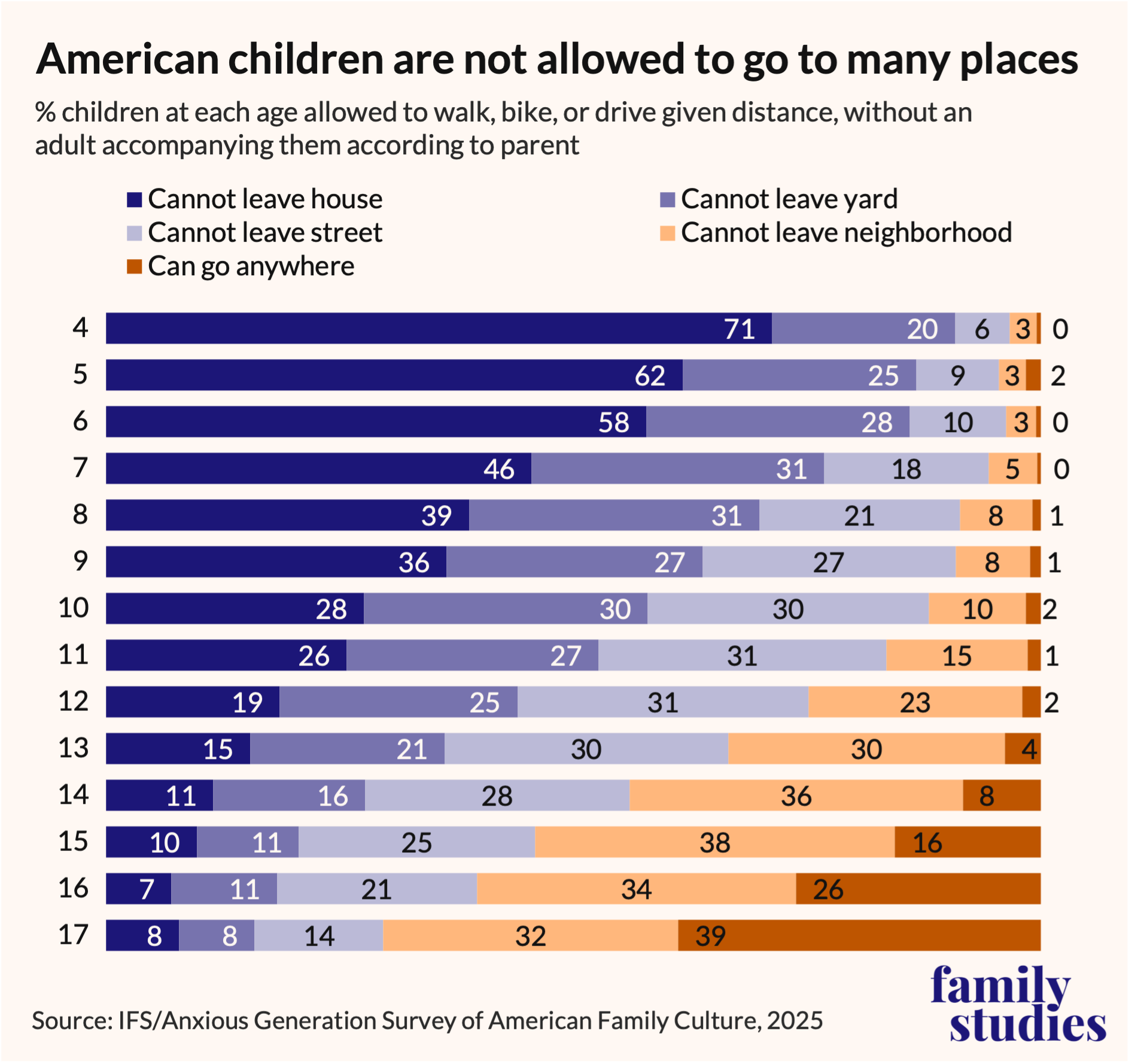
(This and other claims in this section based on a recent and extensive survey of over 23,000 American parents of over 40,000 children, including over 2,000 teens.)
Half of the high school freshmen captured by the study are not allowed to go beyond the street they live on without adult supervision (55% of the 14-year-olds, and 46% of the 15-year-olds, leaving us at 50.5% overall). 62% of the 17-year-olds are not allowed to leave their neighborhood unchaperoned.
The study anticipates a possible objection:
The safety of communities certainly influences household norms around childhood mobility and unsupervised play. On the other hand, due to the size of our sample, covering 24,000 parents and 40,000 profiles of children, the overall patterns we see cannot be explained by such factors alone. Indeed, as we show, at least one kind of neighborhood factor that we checked—walkability—has no impact on what children are allowed to do and where they are allowed to go.
The study also points out that:
…despite the documented developmental benefits of play, independence, and mobility for children, we find that most American parents believe that children today are under-supervised. In fact, 62% of all parents in our sample said that 8 to 12-year-old children should receive more supervision than they currently do. We find no meaningful differences on this issue between religious and secular—nor between conservative and liberal—parents. All of these groups want more childhood supervision.
This is also true for parents of different levels of educational attainment. We find a majority of groups, from those without a high school diploma to those with a graduate degree, who also believe that kids are under-supervised.
…though it acknowledges that, while the parents with a graduate degree still overall think 8-to-12s should be more supervised than they presently are, they’re ten percentage points less likely to think so than less educated/privileged parents.
IV.
Another of my pet projects is a curriculum on “defense against the Dark Arts,” in which I am building a taxonomy of social manipulation (I recently presented a first draft of the taxonomy at a talk in San Francisco as a birthday present to myself).
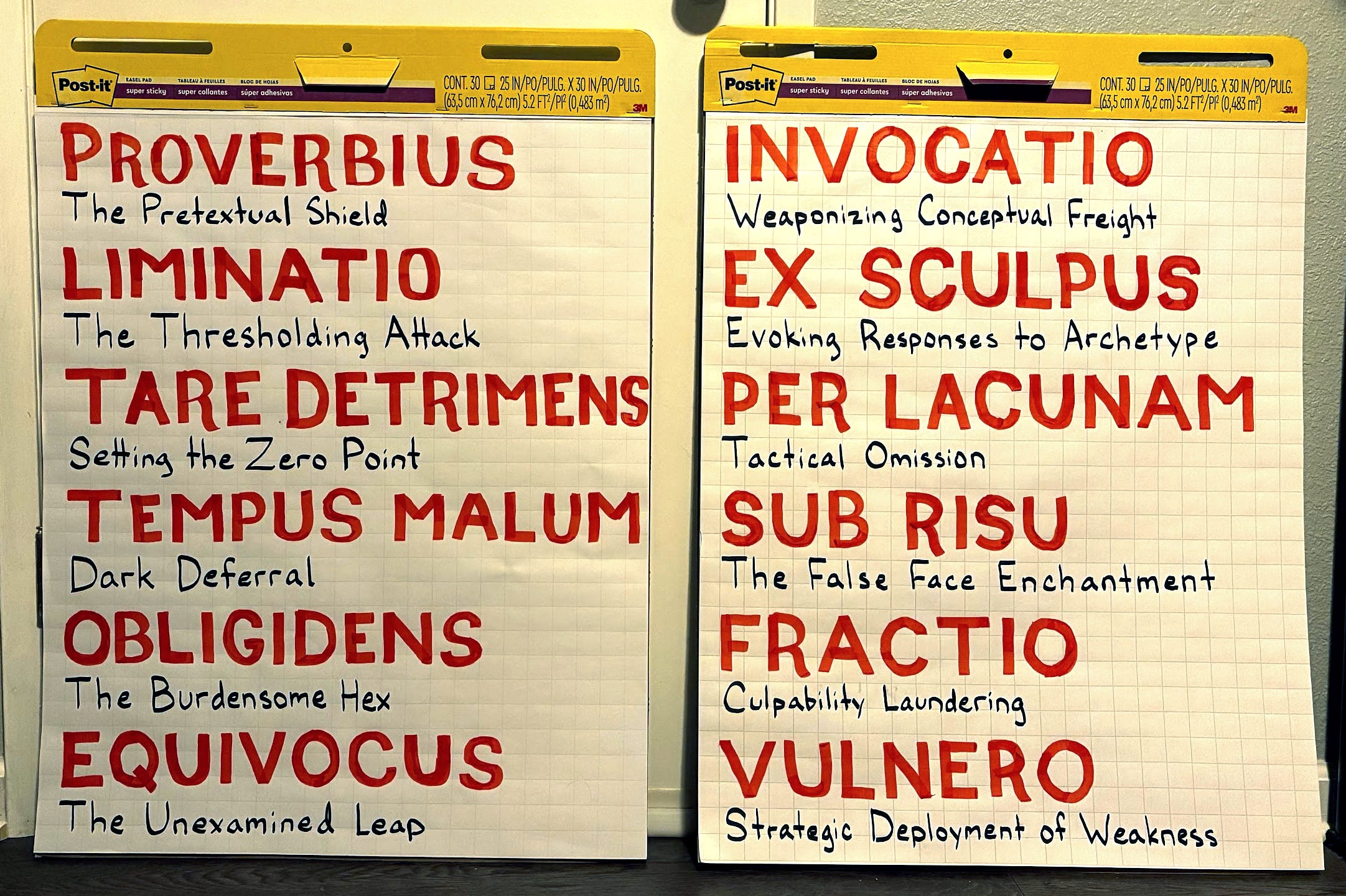
By loose analogy to martial arts: different martial arts have all sorts of different unique properties, but you could model every martial art as being made up of kicks, punches, knee/elbow/palm/forearm strikes, chokes/holds/locks, and sweeps or throws, with a little bit of leftover miscellany for things that don’t fit cleanly into any of those conceptual buckets. Similarly, it’s possible to conceptualize and categorize social manipulation as being mostly made up of a small number of describable dynamics.
One such dynamic, analogous to “punches,” is “creating costs that you do not yourself pay.” When people are socially licensed to create costs that they do not themselves pay, this inevitably results in bad things. Some people directly abuse the dynamic; others do so by accident; still others because it simply becomes normalized and it doesn’t even occur to them not to.
(Few people who owned slaves didn’t order those slaves around, even if they were extra nice about it.)
And the parents (and teachers, and coaches, and day care workers, and the eyebrow-raisers who pressure them, and the child protective services apparatus that looms threateningly over them all), are stealing something deeply and irreplaceably precious from the children, to those children’s enduring detriment.
And while it’s not the case that the adults are paying no cost—
(In many ways, the adults are making their own lives worse, too, by allowing an impossibly large burden of supervision and care to settle on their shoulders.)
—the main cost is one whose pain they do not feel and whose downstream effects they did not themselves experience and do not viscerally understand. The screws are tightening, generation by generation, and parents are consistently and repeatedly denying their children the freedoms that they themselves experienced. My parents gave me less freedom than they got, and other parents in my generation are giving their kids less freedom than we got.
The relevant word is “atrophy,” with an extra-bleak dash of Kafka-esque injustice, that the atrophied and incompetent state of kids and teens is then recycled into post-hoc justification for even further restriction, because of how patently unready they are to handle themselves unsupervised.
V.
I am tired.
I am tired in a way that I believe is probably a pale shadow of the exhaustion felt by e.g. women of color, as they navigate a world that is structurally hostile toward them.
I understand that the vast, vast, vast majority of people are not setting out to harm the children.
I understand that the vast, vast, vast majority of people are well-intentioned, and often lack the capacity to even think such questions through for themselves, as opposed to simply having to take their cue from their neighbors.
(And even those who do have the breathing room to think it through do not necessarily have the privilege required to actually do better. Many slave owners didn’t realistically have the option of opting out of the slave culture, even if they wanted to.)
I know, I know, I know that most people are just … beleaguered, and bewildered, and doing the best that they can, and are not in fact reasonable targets for my fire and fury, here. I know that many of them are anxious, and they are trying to keep their kids in close proximity so that they do not fret and worry.
But I am so tired of politely pretending that they are not harming their kids. I’m so tired of validating their good intentions, and their limited resources, as they chain and confine their children, robbing them of their privacy, robbing them of their autonomy, inflicting upon them amounts of confinement that only barely fall short of the confinement we impose upon actual criminals, allegedly justified by an increase in safety that is not real.
Sometimes, I want to just grab them by the lapels, and scream that I do not care that they are anxious and worried or that everyone else is doing it, that is not sufficient justification for crippling and infantilizing the children whose well-being they are supposed to put first, it’s your fucking job to actually check whether these hideous restrictions are doing anything at all, you should notice that they are not actually paying for themselves, you are making the world worse for your children and you’re not even getting anything good out of it.
(I don’t actually do this, because it will not work.)
(I don’t always manage to distinguish between actions whose sole effect is to make me feel better, and actions that actually improve the problem, but I do at least try.)
But I am tired.
I am tired of the bad guys calling themselves the good guys, and walking around patting one another on the back for what good parents they are, when they are not.
In a more just world, they would at least have to admit that they are jailers, even if nothing else was materially different.
And in an actually adequate world, they’d let their fucking kids have lives outside of their fascist panopticon. Life should not begin with an eighteen-year prison sentence, and parents should not be their children’s first abusers. Adulthood should not start with stumbling, blind and atrophied, into a world in which you have not ever been permitted to flex your muscles and try your hand.
We know that this is bad.
So please stop.
See also: https://www.lesswrong.com/posts/Hoh6umyMWSqzPGMJZ/social-behavior-curves-equilibria-and-radicalism
These same people, who claim their smothering conduct is making kids safer, will point to those very gun violence statistics as justification to ratchet up restrictions even further. It's maddening.